The Invisible Trap: How Hackers Weaponize the Internet’s Root Infrastructure (.arpa) to Bypass Security
 Do Son
We all know the standard signs of a phishing email: bad spelling, urgent demands, and sketchy-looking “.com” web addresses. But as everyday internet users have gotten smarter, cybercriminals have had to get far more creative.
As a new report from cybersecurity firm Infoblox points out, “Phishing email campaigns are so common that it takes something fundamentally different to stand out.” Recently, threat actors have found that “something different.” They have figured out how to hijack the very infrastructure of the internet—a hidden domain space known as .arpa—to sneak past standard security alarms and deliver malicious scams right to your inbox.
To the average victim, the attack doesn’t look like a complex cyber threat. It usually arrives as an email impersonating a major, trusted brand like Lowe’s, Kroger, Macy’s, or Norton. The email might promise a “free holiday gift,” a premium meat box, or warn that a security subscription has expired.
The entire email is usually just a single, clickable image. By hiding the link inside a picture, the attackers ensure the victim never sees the bizarre web address they are about to visit.
If you click that image, you aren’t taken to a normal website ending in .com or .org. Instead, you are sent to a massive string of random letters and numbers ending in .ip6.arpa.
To understand why this is so dangerous, you have to understand what the .arpa domain is. Unlike consumer-facing websites, .arpa is strictly meant for the internet’s background plumbing. It is used by network operators for “reverse DNS”—essentially the internet’s internal phonebook that maps IP addresses back to domain names. It was never designed to host actual websites.
Because .arpa is a critical part of how the internet functions, security scanners and firewalls typically ignore it. They assume anything ending in .arpa is safe, background traffic.
The Infoblox researchers highlight exactly why this is a nightmare for defenders: “The abuse of the .arpa TLD is novel in that it weaponizes infrastructure that is implicitly trusted and essential for network operations.”
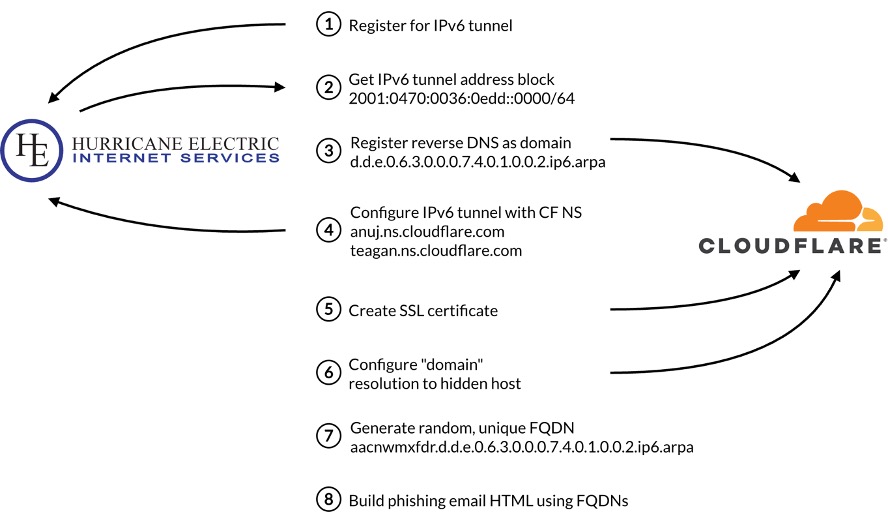
To pull this off, the attackers use free “IPv6 tunnels”—services designed to help older internet networks talk to newer ones. By claiming a block of these free IP addresses, the hackers trick domain providers into giving them administrative control over the corresponding .arpa domains. From there, they can point these trusted infrastructure domains toward servers hosting their fake “free gift” websites.
Even if a security researcher spots the malicious link, the hackers have another trick up their sleeve. When someone clicks the link, they are sent through a “Traffic Distribution System” (TDS).
Think of a TDS as a digital bouncer. It quickly analyzes the visitor’s traffic. If the bouncer sees that the visitor is using a mobile phone on a home Wi-Fi network (the ideal target), it sends them to the malicious scam page. If the bouncer suspects the visitor is a security researcher using a corporate computer, it simply shows an error page or redirects them to a harmless site like TikTok.
The report also uncovered that these same attackers are using a second sneaky tactic: hijacking “dangling” domains.
When a major company, university, or government agency abandons a subdomain (like account.university.edu) but forgets to delete the backend internet records, hackers can swoop in and claim it. Infoblox found over 100 instances where hackers were using the trusted names of local newspapers, global food brands, and universities to host their phishing sites.
Because traditional security tools struggle to block these .arpa domains without breaking the internet, the first line of defense remains the human element. If you receive an unexpected email promising a free gift, especially if the whole email is just one big image, do not click it.
Support Our Threat Intelligence
Find our threat intelligence and malware analysis helpful? Support our work today and unlock a 100% ad-free reading experience!
 Buy Me a Coffee
