The Mainstream Master: Why MediaTek’s Dimensity 7100 is the Secret Weapon for 2026 Mid-Rangers
 Do Son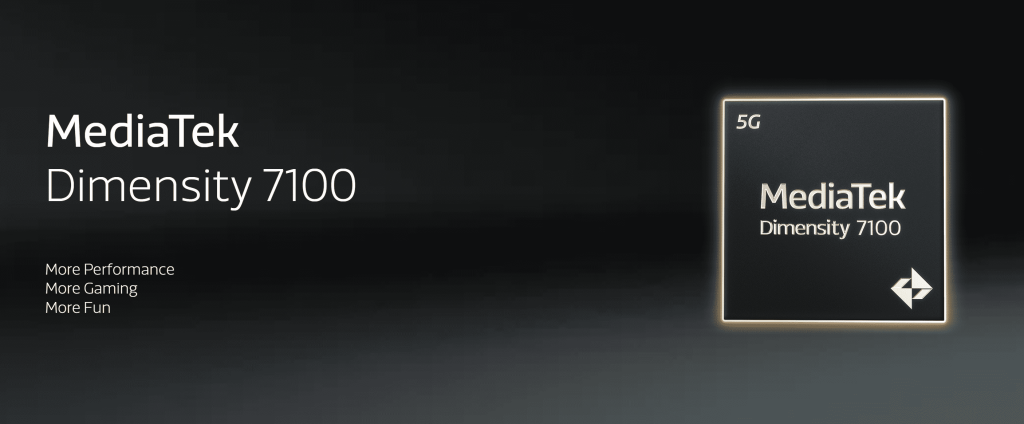
MediaTek has quietly refreshed its official website with a new processor dubbed the Dimensity 7100, positioned squarely in the mainstream segment and clearly intended as a successor to the long-serving Dimensity 7050. While the manufacturing process remains a mature 6nm node, the chip introduces notable revisions to its CPU layout and peripheral capabilities, aiming to strike a new balance between cost efficiency and user experience.
The most conspicuous change lies in the CPU cluster configuration. Departing from the Dimensity 7050’s traditional “2 big cores + 6 small cores” design, the Dimensity 7100 adopts a more symmetrical “4+4” arrangement: four Cortex-A78 performance cores clocked at up to 2.4GHz, paired with four Cortex-A55 efficiency cores reaching up to 2.0GHz.
Although the peak frequency of the performance cores is not especially aggressive, doubling their number delivers tangible benefits in everyday responsiveness—faster app launches and smoother multitasking in particular. On the graphics front, the GPU has been upgraded to an Arm Mali-G610 MC2, with MediaTek claiming an approximate 8% uplift in graphics performance over its predecessor.
Memory and storage options remain flexible, allowing manufacturers to choose between LPDDR4x and LPDDR5 memory depending on cost targets, while UFS 3.1 storage is supported as standard. For mainstream devices, endurance often matters more than raw power, and MediaTek emphasizes efficiency gains across the board: a 5% reduction in power consumption during app usage, a 16% drop in multimedia playback power draw, and a notable 23% improvement in energy efficiency for the notoriously power-hungry 5G modem. Connectivity support includes 5G download speeds of up to 3.3Gbps, Wi-Fi 6 (1T1R), and Bluetooth 5.3.
The Dimensity 7100 also natively integrates 45W fast-charging support, sparing device makers the expense of additional charging ICs and enabling even budget-friendly models to deliver respectable charging speeds—an important lever for further reducing bill-of-materials costs. On the multimedia side, the chip supports primary cameras of up to 200 megapixels, hardware-accelerated facial recognition, multi-frame noise reduction, and DCG/DAG-based HDR video recording. Display output reaches Full HD+ resolution (2600 × 1200) at refresh rates up to 120Hz, aligning neatly with current mid-range smartphone standards.
In my view, the Dimensity 7100 reflects a clear reality of today’s smartphone market: the lower and mid tiers do not need excessive performance, but they do demand consistency and stability.
Shifting the CPU design from “2+6” to “4+4” is a particularly astute move. Given the strong cost advantages of a 6nm process, increasing the number of performance cores to enhance perceived smoothness delivers far better returns than merely pushing clock speeds higher. The native integration of 45W fast charging, meanwhile, directly addresses OEMs’ perennial drive to cut costs.
The Dimensity 7100 is expected to appear in commercial devices in the first quarter of 2026, likely powering models such as the Redmi Note series, realme’s numbered lineup, and vivo’s Y series smartphones.
Related Posts:
- MediaTek Unveils Dimensity 9500, a New King for Mobile AI and Gaming
- Microsoft official End of mainstream support Windows 8.1
- CrowdStrike Global Threat Report: extortion and weaponization of data have become mainstream among cybercriminals
Support Our Threat Intelligence
Find our tech and OS security coverage helpful? Support our work today and unlock a 100% ad-free reading experience!
 Buy Me a Coffee
