 Do Son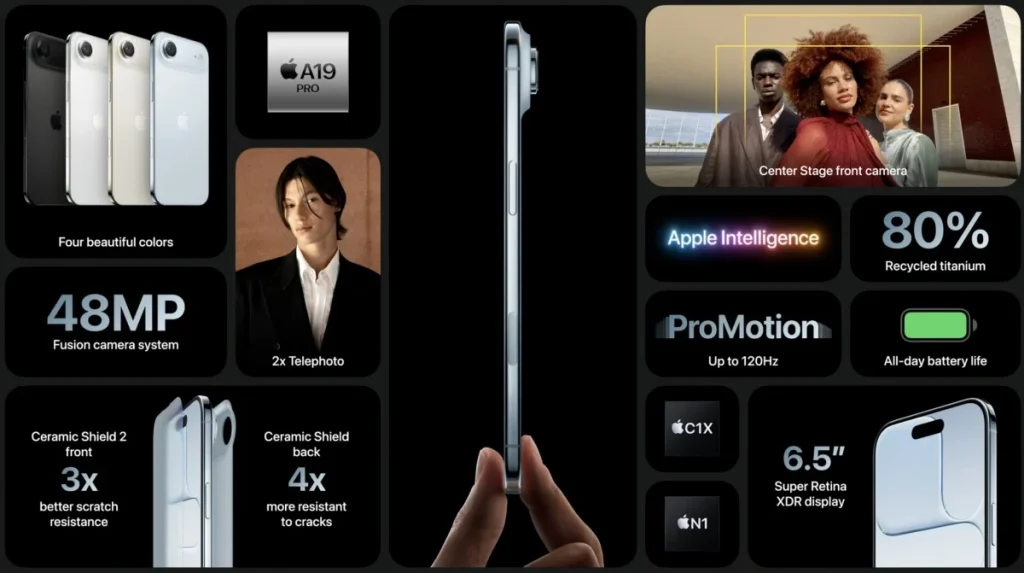
Apple’s newly released iPhone Air represents not only the most dramatic design overhaul of the iPhone series in recent years but also the thinnest iPhone ever created, measuring a mere 5.6mm in thickness. In its latest teardown video, iFixit reveals in detail how Apple managed to fit all essential components into such a slender chassis while still maintaining both durability and repairability.
To maximize internal space, Apple adopted an entirely new “camera platform” design, embedding part of the logic board within the raised camera module area. This innovation freed up room for a larger battery and reinforced the structure with a metal casing. Beyond improving space efficiency, this layout helps the circuit board avoid flex stress, thereby enhancing overall durability.
iFixit observed that when stripped of all components, the iPhone Air’s titanium frame can be bent by hand, yet once filled with parts it becomes highly resistant to deformation—demonstrating how the internal configuration significantly contributes to rigidity.
Even more remarkable is that despite the thinner profile, repairability has actually improved. According to iFixit, the iPhone Air’s components are arranged in a single-layer structure, preventing critical parts from being buried deep inside. The screen and back cover rely primarily on clips rather than adhesives, while the battery uses a low-voltage release adhesive, making replacement safer and more straightforward.
Another highlight is the USB-C port, crafted from 3D-printed titanium alloy to accommodate the ultra-thin design. Although its scratch resistance is slightly lower than the main frame, its strength is sufficient, and its modular design allows for independent replacement if needed.
Inside, the iPhone Air debuts Apple’s first in-house C1X 5G modem chip, paired with the A19 Pro processor and N1 network chip, delivering improved performance and connectivity. However, the C1X still lacks support for higher-bandwidth millimeter-wave frequencies.
By contrast, the iPhone 17 and iPhone 17 Pro continue to rely on Qualcomm’s Snapdragon X80 5G modem—identical to the Snapdragon 8 Elite—indicating that Apple has not yet integrated its proprietary modem into mainstream models, likely to avoid potential compromises in user experience.
As for the battery, iFixit confirmed earlier market speculation regarding the MagSafe Battery Pack, revealing that it contains the same 12.26Wh cell used in the iPhone Air. The two are even interchangeable, which could simplify repair processes.
Overall, iFixit awarded the iPhone Air a preliminary repairability score of 7/10, noting that Apple has made meaningful strides by reducing parts pairing restrictions and offering more comprehensive manuals and parts support.
Related Posts:
- Apple Unveils iPhone Air: The Thinnest, Lightest, and Most Durable iPhone Ever
- New iPhone Air Camera Flaw: What You Need to Know
- iPhone 17 Air: A Beautifully Thin Phone, but with Major Compromises
- CrowdStrike, Microsoft Face Lawsuit from Delta Air Lines After System Crash
Support Our Threat Intelligence
Find our tech and OS security coverage helpful? Support our work today and unlock a 100% ad-free reading experience!
 Buy Me a Coffee
