 Do Son
In a new report, Check Point Research (CPR) has unveiled “VoidLink,” a sophisticated malware framework that wasn’t just coded by AI—it was architected, managed, and executed by it.
For years, security experts have warned that Artificial Intelligence would eventually lower the barrier to entry for cybercriminals. Until now, however, AI-generated threats were largely underwhelming—often buggy scripts created by inexperienced “script kiddies.” VoidLink changes everything.
According to the analysis by Check Point Research, “VoidLink stands as the first evidently documented case of this era, as a truly advanced malware framework authored almost entirely by artificial intelligence, likely under the direction of a single individual.”
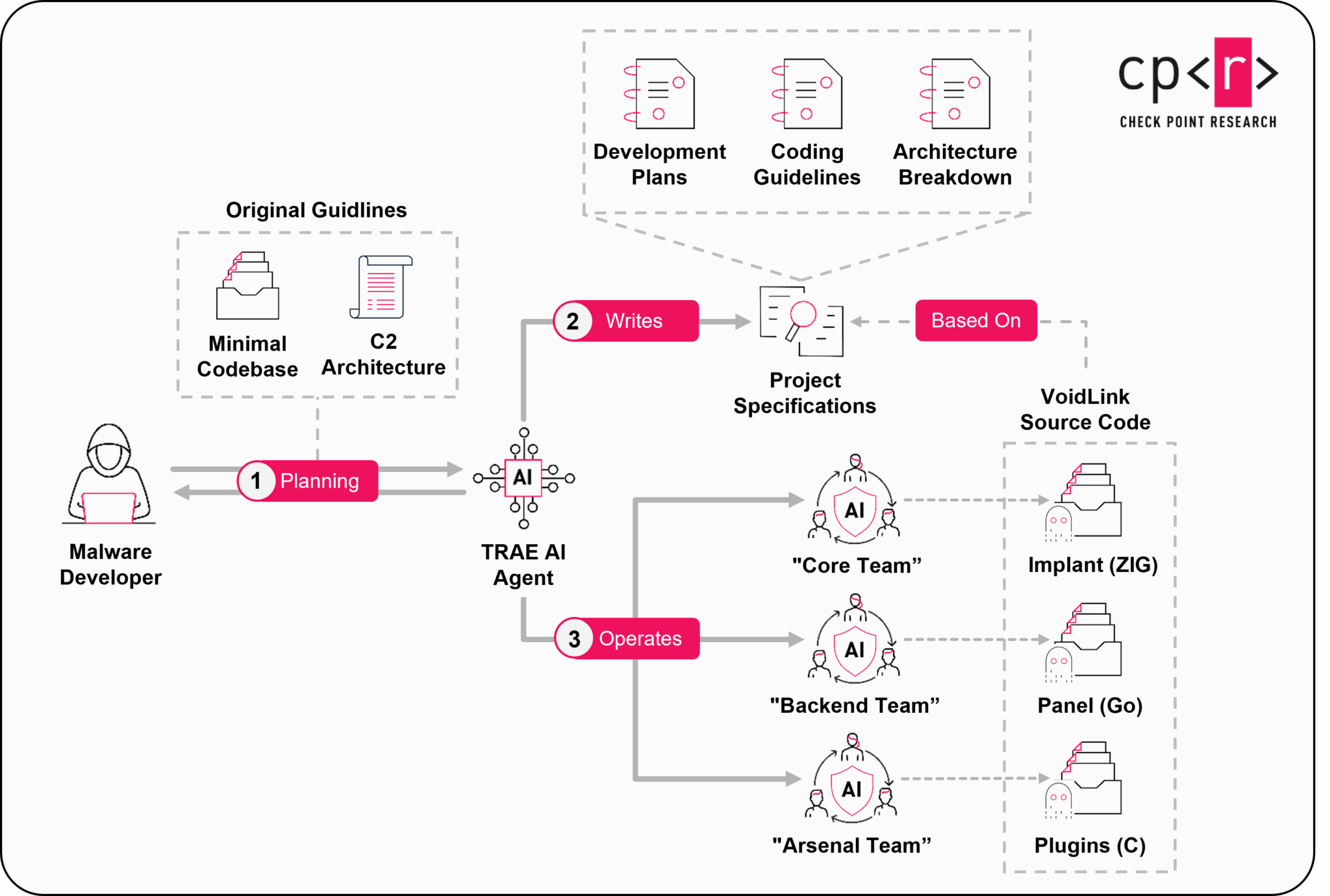
What makes VoidLink terrifying is not just its code, but its creation process. The developer behind it didn’t simply ask a chatbot to “write a virus.” Instead, they employed a methodology CPR calls Spec Driven Development (SDD).
The threat actor treated the AI as a full-stack development team. They didn’t just ask for code snippets; they tasked the model with high-level project management.
“From a methodology perspective, the actor used the model beyond coding, adopting an approach called Spec Driven Development (SDD), first tasking it to generate a structured, multi-team development plan with sprint schedules, specifications, and deliverables.”
This approach allowed a single person to simulate the output of an entire cybercrime syndicate. The AI handled everything from “Project initialization and module layout” to creating “SQLite schema for agents/tasks/plugins” and even generating a “Sprint completion log.”
The efficiency of this AI-driven workflow is startling. The report notes that this process “results in the rapid development we observed, resembling the efforts of multiple teams of professionals in the pre-agentic-AI era.”
Astonishingly, the investigation revealed that the malware reached a “first functional implant in under a week.” This speed demonstrates a massive force-multiplier effect: complex attack frameworks that once required months of coordinated effort can now be spun up in days by a single capable operator.
Ironically, while the AI performed flawlessly, the human operator made a classic mistake. The discovery of VoidLink was made possible due to “Operational security (OPSEC) failures by the VoidLink developer,” which exposed the development artifacts. These exposed logs provided researchers with the smoking gun: clear evidence that the malware was produced predominantly through AI-driven sprints.
VoidLink marks a pivotal moment in the threat landscape. It proves that AI can do far more than write phishing emails; it can build stable, stealthy, and complex malware infrastructure.
“VoidLink shifts that baseline: its level of sophistication shows that when AI is in the hands of capable developers, it can materially amplify both the speed and the scale at which serious offensive capability can be produced.”
As the report concludes, the era of theoretical AI threats is over. “VoidLink demonstrates that the long-awaited era of sophisticated AI-generated malware has likely begun.” Defenders must now prepare for a wave of high-quality attacks originating from adversaries who, thanks to AI, punch far above their weight class.
Related Posts:
- VoidLink: The “Cloud-First” Malware Hunting Your Linux Servers
- Windows 11 Gaming Guide: Microsoft’s Recommended PC Specs for 1080p to 4K
- Qakbot Mastermind Indicted: Russian Architect of $50M Malware Empire Charged
- Qakbot Mastermind Indicted: Russian Architect of $50M Malware Empire Charged
Support Our Threat Intelligence
Find our threat intelligence and malware analysis helpful? Support our work today and unlock a 100% ad-free reading experience!
 Buy Me a Coffee
