 Do Son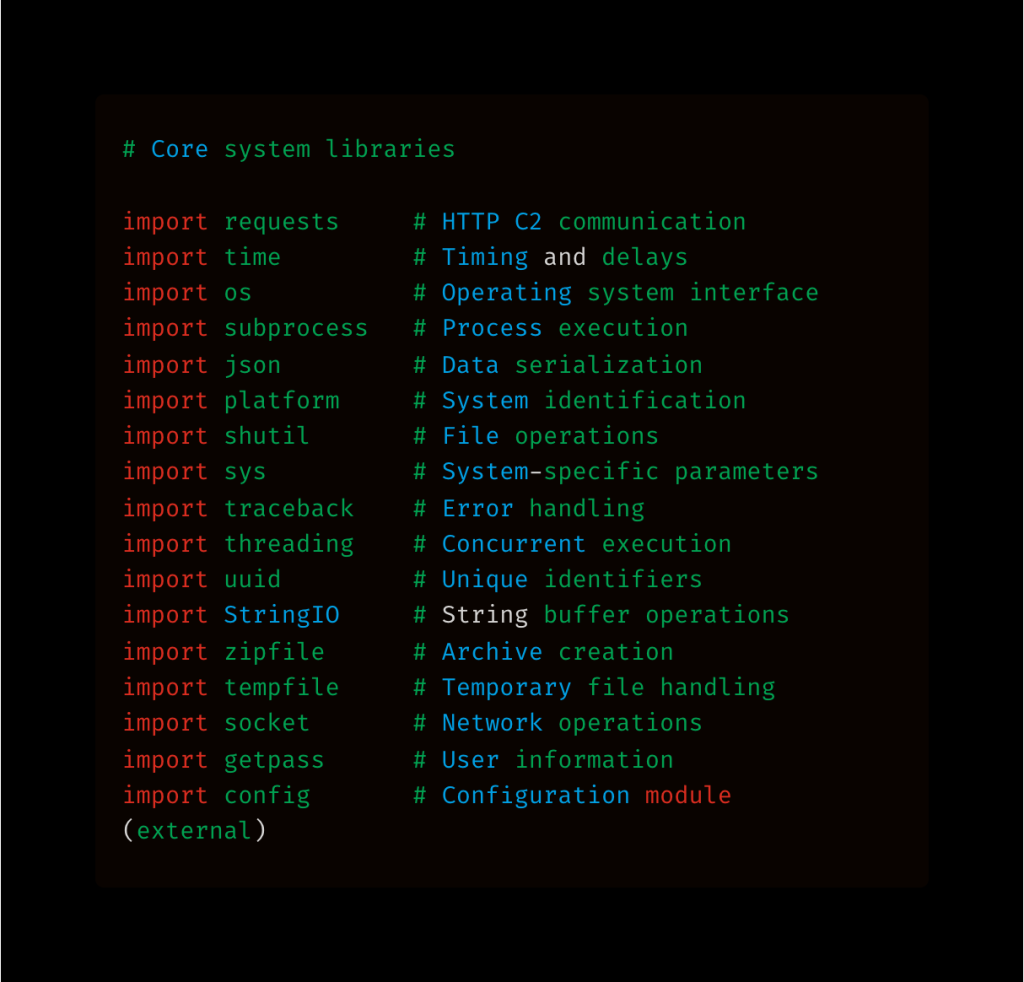
Imported modules | Image: K7 Labs
In a landscape often dominated by complex, state-sponsored malware, a new threat has emerged that proves simplicity can be just as dangerous. Researchers at K7 Labs have analyzed a sophisticated Python-based Remote Access Trojan (RAT) that wraps itself in an innocent-looking ELF binary to target systems across different platforms.
The analysis, sparked by a suspicious sample found on VirusTotal, reveals a malware strain that prioritizes stealth and persistence over flashiness. By bundling Python scripts into an executable, the attackers have created a weapon that is easy to deploy but hard to shake.
The malware appears as a standard ELF binary—a common executable format on Linux and Unix systems. However, inside this shell lies a fully functional Python environment.
Using tools like pyinstxtractor, the researchers were able to peel back the layers. “While investigating samples in VirusTotal, we found this binary… interesting as it was coded in the widely used scripting language ‘Python’, which encouraged us to analyze it further”.
This packaging technique allows the malware to bypass simple file-extension filters and run on systems that might not suspect a Python script to be a threat until it’s too late.
One of the RAT’s most distinct features is its ability to “breathe” quietly on the network. Instead of constantly shouting back to its command-and-control (C2) server—a behavior that often triggers security alarms—this malware uses Adaptive Beaconing.
The analysis highlights a specific logic block where the malware checks if it is idle. “This code implements adaptive beaconing, where the malware dynamically adjusts its network communication based on its activity state”.
When the malware is active and receiving commands, it polls the server rapidly (every 0.5 seconds). But when it has nothing to do, it goes into a deep sleep, waiting for longer intervals (config.HELLO_INTERVAL) to minimize its network footprint.
If the malware suspects it has been caught or needs to self-destruct, it comes equipped with a comprehensive Anti-Forensics suite. The researchers identified a “Data Cleanup” module designed to scrub the victim machine clean of any evidence.
The cleanup routine includes:
- Complete Cleanup: Removing all persistence mechanisms.
- Registry Cleanup: Deleting specific Windows Registry keys.
- File System Cleanup: Wiping the installation directory.
- Post-Reboot Cleanup: Utilizing RunOnce to ensure traces are gone even after a restart.
While this RAT might not bear the hallmarks of a top-tier APT group, its effectiveness lies in its accessibility. It represents a growing trend where cybercriminals leverage widely supported languages like Python to build versatile tools.
As the report concludes: “This Python-based RAT poses a notable risk to organizations because of its cross-platform capability, broad functionality, and ease of deployment”.
Defenders are advised to look beyond standard executable signatures and inspect Python-packaged binaries for anomalous behavior. “Even though it is not associated with highly sophisticated threat actors, its effectiveness in real-world attacks and observed detection rates indicate that it is actively used by cybercriminals and deserves attention”.
Related Posts:
- Google Chrome scans files on users’ computers
- RedisRaider Worm Exploits Misconfigured Redis for Cryptojacking
- Cisco releases the security updates to fix flaws in multiple Cisco products
- France Leads International Effort to Eradicate PlugX Trojan from 3,000 Systems
Support Our Threat Intelligence
Find our threat intelligence and malware analysis helpful? Support our work today and unlock a 100% ad-free reading experience!
 Buy Me a Coffee
