Exploiting the Crisis: Chinese APTs Weaponize Middle East Tensions to Target Qatar with PlugX
 Ddos
Ddos 
Following recent regional escalations, researchers have identified a sharp increase in activity from Chinese-nexus APT (Advanced Persistent Threat) actors, specifically focusing on targets in Qatar. This shift demonstrates how rapidly state-sponsored espionage can pivot to exploit breaking news and geopolitical instability.
Just one day after the launch of “Operation Epic Fury,” the threat actor known as Camaro Dragon (also linked to Earth Preta and Mustang Panda) deployed a variant of the PlugX malware against Qatari targets.
By using lures disguised as “photos of attacks on American bases in Bahrain,” the attackers created highly engaging content designed to blend into fast-moving regional communications.
The infection process is notably complex:
- Initial Vector: A ZIP archive containing a malicious LNK file.
- Payload Retrieval: The LNK file executes, contacting a compromised server to download a next-stage payload.
- Execution: The chain ultimately abuses DLL hijacking of a legitimate Baidu NetDisk binary to deploy the PlugX backdoor.
PlugX remains a favorite for these actors due to its modular architecture, allowing for file exfiltration, screen captures, and remote command execution. Interestingly, this same delivery method was spotted months earlier targeting the Turkish military, suggesting a sustained, broader focus on the Middle East.
A second, separate campaign has also surfaced, likely targeting Qatar with lures titled “Strike at Gulf oil and gas facilities”. This operation stands out for its use of low-quality AI-generated content impersonating the Israeli government to trick users.
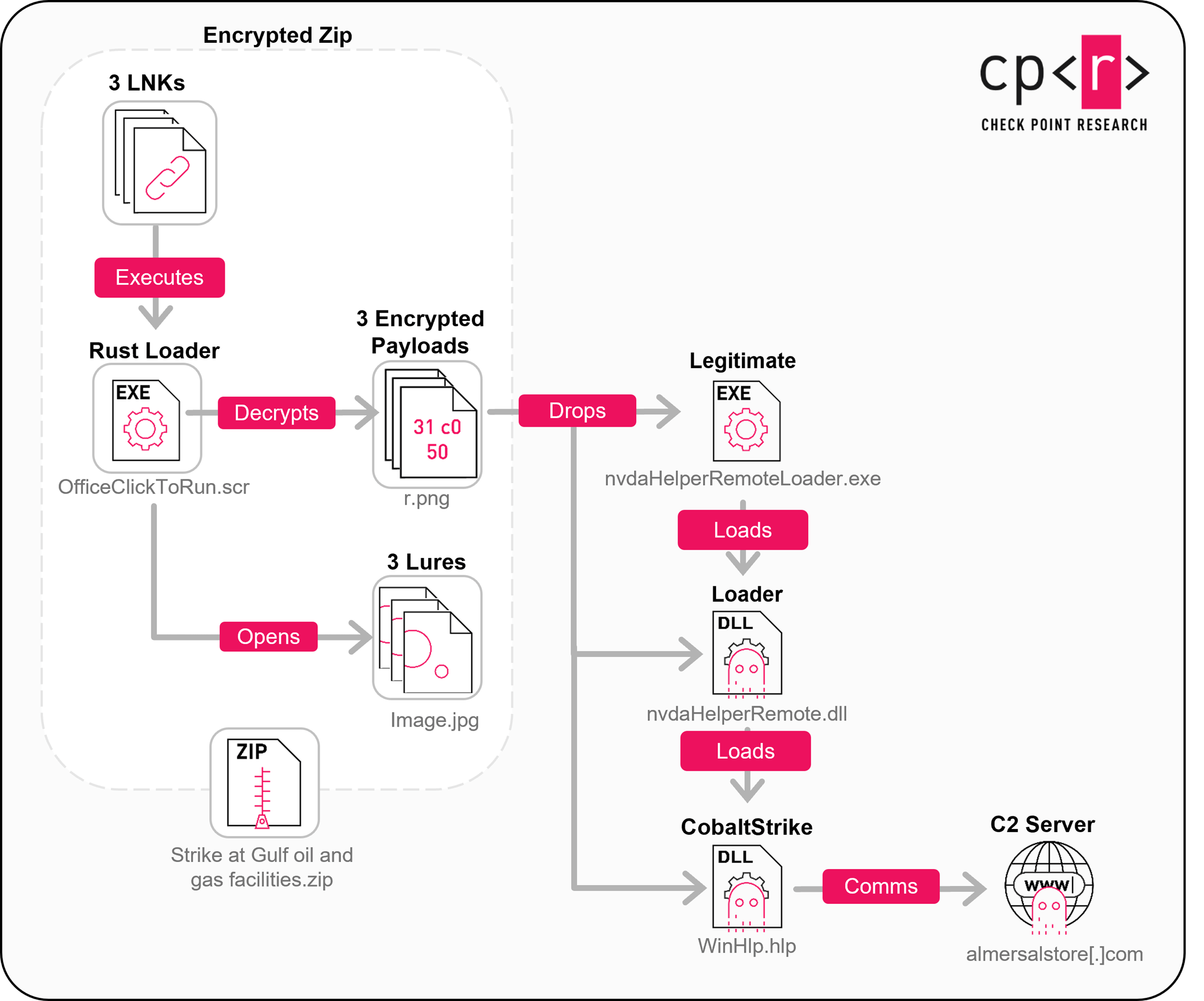
This campaign utilizes a previously unseen Rust-based loader:
- DLL Hijacking: The loader exploits nvdaHelperRemote.dll, a component of the open-source NVDA screen reader.
- Repurposed Tools: The final payload is Cobalt Strike, a penetration testing framework often used by attackers for rapid reconnaissance and to assess if a deeper intrusion is worthwhile.
- Attribution: While assessed with “low confidence” as China-aligned, the TTPs (Tactics, Techniques, and Procedures)—including the NVDA hijacking and specific C2 infrastructure—match patterns previously seen in Chinese-nexus activity.
The Gulf region hasn’t always been the primary headline for Chinese-nexus cyber activity, but that is changing. The near-immediate focus on Qatar following regional conflict suggests a shift in collection priorities.
Support Our Threat Intelligence
If you find our CVE report and cybersecurity news helpful, consider supporting our work.
 Buy Me a Coffee
PayPal
Buy Me a Coffee
PayPal
