 Do Son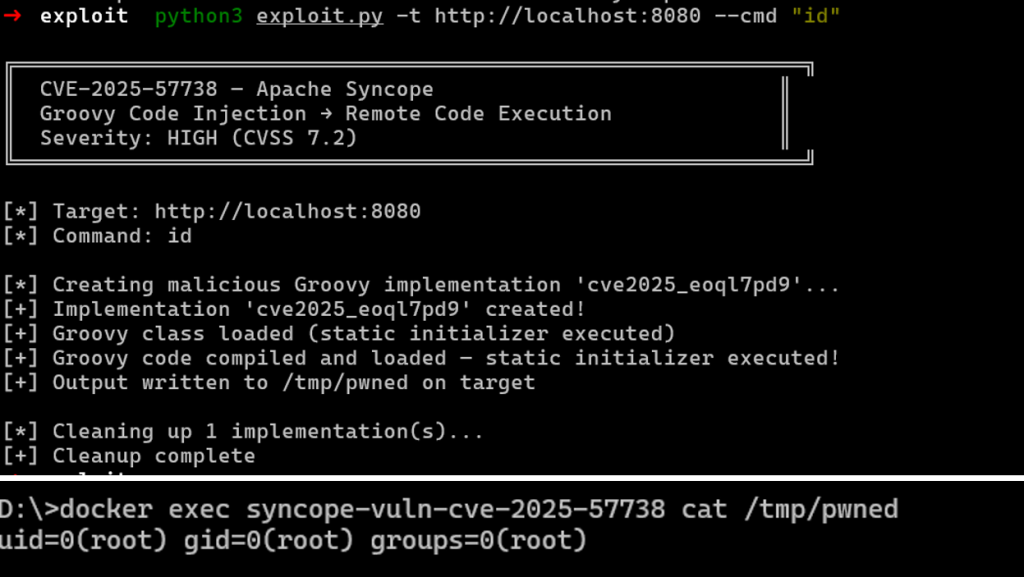
A new report from SecureLayer7 has unmasked a high-severity Remote Code Execution (RCE) vulnerability in Apache Syncope, a cornerstone of identity lifecycle management and access governance in many enterprise and government environments, that allows an authenticated administrator to seize full control of the host system.
The flaw, tracked as CVE-2025-57738 with a CVSS score of 7.2, strikes at the heart of how Syncope handles custom business logic.
To allow for deep customization, Syncope permits administrators to upload “Implementations”—custom Java or Groovy classes—via its REST API. However, in vulnerable versions, these Groovy implementations are compiled using a “bare GroovyClassLoader with no sandbox, no CompilerConfiguration, and no AST restrictions”.
This lack of isolation is catastrophic. According to the analysis, “the compiled Groovy code has unrestricted access to the entire JVM API surface,” including sensitive functions like Runtime.exec(), ProcessBuilder, and direct file and socket access. Because Syncope often runs with high-level permissions, particularly in containerized environments, the malicious code executes with “full privileges of the Syncope process (typically root in containers)”.
The full technical details of the vulnerability and a functional proof-of-concept (PoC) exploit code have been publicly disclosed. The PoC provides a turnkey solution for replicating the attack.
The exploit leverages a fundamental behavior of Java and Groovy: the static initializer. By placing malicious code inside a static { } block, an attacker ensures the payload runs the moment the class is loaded. As the researchers warn, “code execution occurs before Syncope validates the class interface,” meaning the damage is done during the compilation phase, regardless of whether the server eventually rejects the class as invalid.
The real-world consequences of this flaw were demonstrated using a standard Docker-based deployment of Syncope. By running a simple Python-based exploit script against the target, researchers were able to execute the id command and confirm their status.
“The docker exec command confirms that the Groovy static initializer executes with root privileges inside the container, providing full remote code execution,” the report wrote. The output uid=0(root) serves as a confirmation that an attacker can achieve unrestricted access to the target system.
“The root cause is CWE-653: Improper Isolation or Compartmentalization,” the report concludes. The vulnerability exists due to a “static initializer side effect” combined with a total lack of a security sandbox for user-supplied code.
To mitigate this public threat, security teams are urged to move to Apache Syncope version 3.0.14 or 4.0.2.
Support Our Threat Intelligence
Find our vulnerability reports and weekly recaps helpful? Support our work today and unlock a 100% ad-free reading experience!
 Buy Me a Coffee
