Cloud Engineering at Risk: AWS Patches Critical Privilege Escalation and RCE Flaws in RES
 Do Son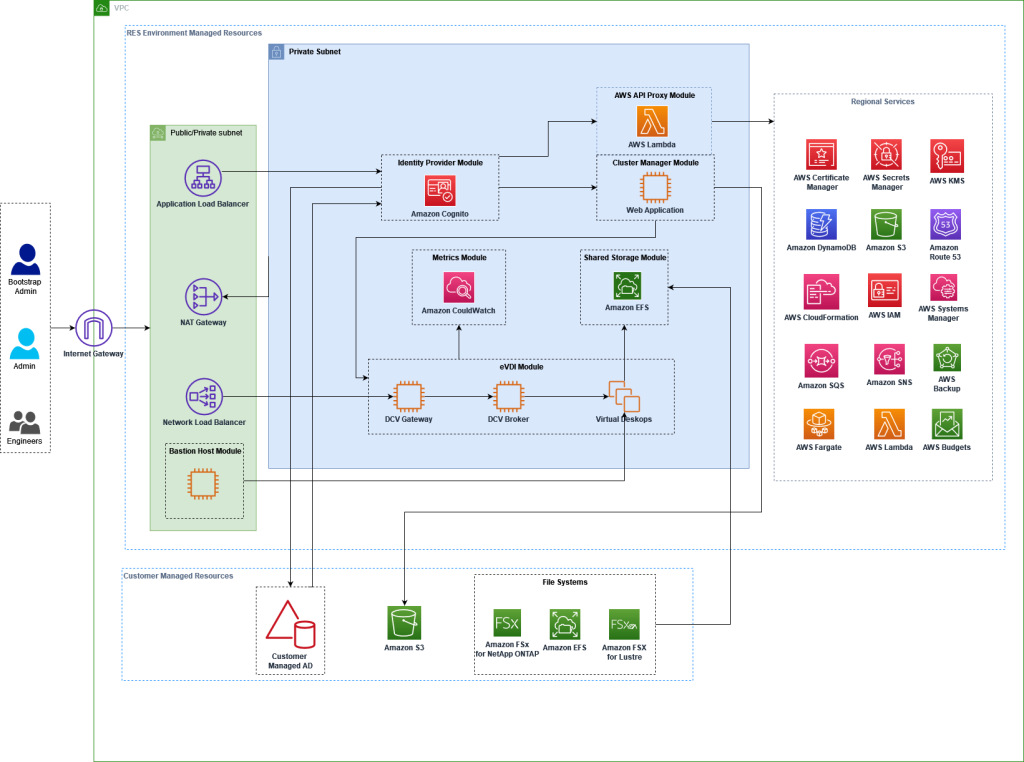
Research and Engineering Studio on AWS architecture | Image: AWS
Amazon Web Services (AWS) has released urgent security updates for its Research and Engineering Studio (RES), an open-source portal designed to help administrators manage secure cloud-based research environments. The update addresses a trio of high-severity vulnerabilities—tracked as CVE-2026-5707, CVE-2026-5708, and CVE-2026-5709—that could allow authenticated attackers to seize root control of virtual desktops and escalate privileges across the broader AWS infrastructure.
The most direct threat to virtual desktop security is CVE-2026-5707 (CVSS 8.8). Researchers discovered that the studio’s handling of session names lacked proper sanitization. By crafting a specifically malicious name for a virtual desktop session, a remote authenticated actor can bypass security boundaries.
“Unsanitized input in an OS Command in the virtual desktop session name handling… might allow a remote authenticated actor to execute arbitrary commands as root on the virtual desktop host via a crafted session name,” the advisory warns.
This flaw effectively turns a standard management feature into a vehicle for full machine compromise.
While the session name flaw targets individual desktops, CVE-2026-5708 (CVSS 8.8) poses a significant risk to the entire cloud environment. This vulnerability stems from “improper control of user-modifiable attributes” during the session creation process.
By sending a crafted API request, an authenticated user can escalate their privileges far beyond their intended scope.
“This might allow an authenticated remote user to escalate privileges and assume the Virtual Desktop Host instance profile permissions and interact with other AWS resources and services…,” the advisory explains.
In essence, an attacker could use this foothold to “pivot” out of the research studio and begin interacting with other sensitive AWS services under the guise of a highly privileged host.
Rounding out the trio is CVE-2026-5709 (CVSS 8.8), which targets the FileBrowser functionality within RES versions 2024.10 through 2025.12.01. Similar to the session name flaw, this vulnerability is rooted in unsanitized input. An attacker can leverage this API to execute arbitrary commands, this time targeting the cluster-manager EC2 instance—the brain of the research environment.
These vulnerabilities impact all versions of AWS Research and Engineering Studio (RES) up to and including 2025.12.01.
AWS has addressed these issues in RES version 2026.03. Administrators are strongly urged to:
- Upgrade Immediately: Move to the latest version to ensure all three attack vectors are closed.
- Patch Forked Code: If your organization uses a forked or derivative version of RES, ensure the new security fixes are manually incorporated.
- Apply Temporary Mitigations: For environments that cannot be updated immediately, AWS has provided specific mitigation instructions for “Preventing Command Injection via Session Name” and “Privilege Escalation via Instance Profile Injection”.
Support Our Threat Intelligence
Find our vulnerability reports and weekly recaps helpful? Support our work today and unlock a 100% ad-free reading experience!
 Buy Me a Coffee
