 Do Son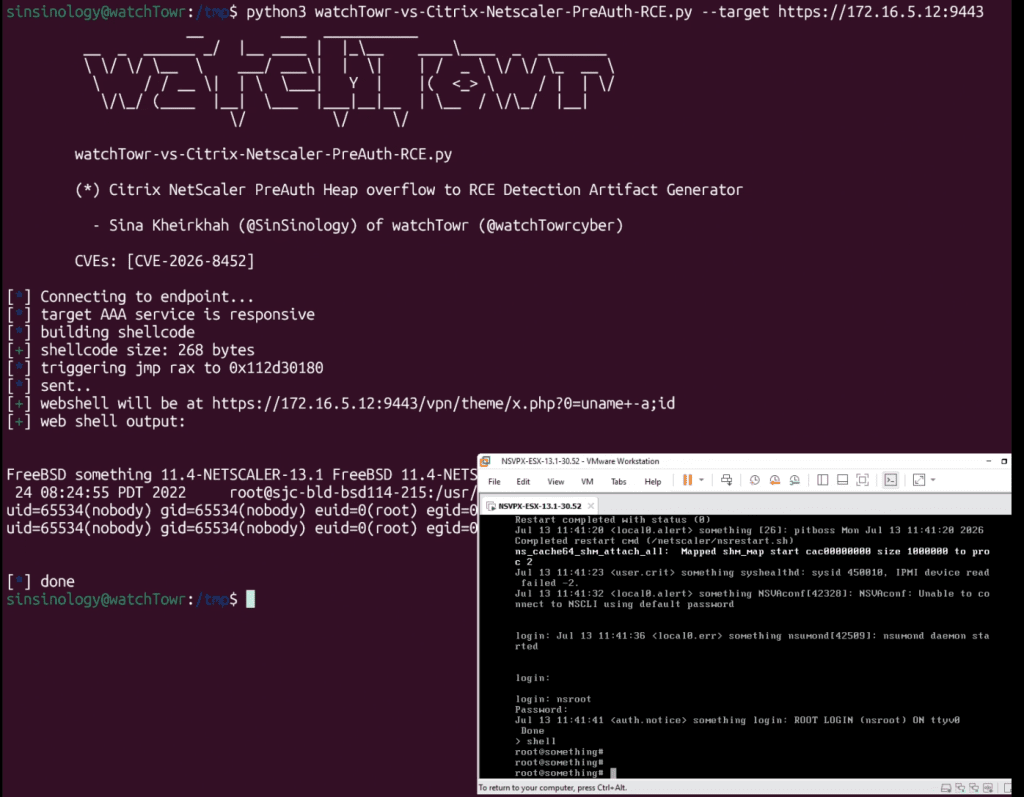
Researchers at watchTowr published a working exploit for a Citrix NetScaler RCE flaw this week. The bug, CVE-2026-8452, lets an unauthenticated attacker run code as root on the appliance. watchTowr released both the technical write-up and proof-of-concept code publicly. So, the barrier to attack just dropped sharply.
- CVE: CVE-2026-8452
- CVSS: 9.8 (High · CVSSv3)
- Product: NetScaler ADC
- Affected: 14.1, 13.1, 14.1 FIPS, 13.1 FIPS and NDcPP
- Impact: Memory overflow vulnerability leading to unpredictable or erroneous behavior and Denial of Service
- Status: Exploited in the wild
- Patched in: 72.61, 63.18, 37.272
- EPSS: 1.0% (30-day)
- Action: Update to 72.61, 63.18, 37.272 now
Why It Matters
NetScaler ADC and Gateway sit at the edge of thousands of enterprise networks. They handle VPN access, load balancing, and single sign-on for remote staff. So, one flaw here hands an attacker the front door to the whole network. This Citrix NetScaler RCE bug needs no login and no user click. That combination makes it a prime target for mass scanning.
How the Attack Works
A SAML Canonicalization Overflow
Citrix first described CVE-2026-8452 as a denial-of-service issue. But watchTowr’s public analysis shows it goes much further. The flaw lives in how NetScaler handles SAML signature canonicalization. During that step, the appliance copies attacker-controlled data from a SAML message into a fixed-size buffer. Crucially, older versions skip the size check. So, an oversized value spills past the buffer and corrupts nearby memory.
From Overflow to Root Code Execution
watchTowr turned that overflow into a write-what-where primitive. From there, the team reached full control of the instruction pointer. Because the binary lacks modern protections like ASLR, they mapped a reliable path to root code execution. The researchers documented every step in their public write-up. They also released the proof-of-concept exploit on GitHub. That level of public detail moves this Citrix NetScaler RCE from theory to practice.
Affected Versions
The flaw affects appliances set up as a Gateway or an AAA virtual server. Those are among the most common NetScaler deployments in the field. Citrix lists two affected version ranges in its advisory. NetScaler ADC and Gateway 14.1 before 14.1-72.61 are vulnerable. NetScaler ADC and Gateway 13.1 before 13.1-63.18 are also affected. Citrix confirmed its own managed cloud services were patched before disclosure. Only customer-managed appliances remain at risk.
Exploitation Status
Michael Tucker of JPMorgan Chase’s XOR team was credited alongside watchTowr for the discovery. As of publication, no source confirms exploitation of CVE-2026-8452 in the wild. Still, a public proof-of-concept now exists, which sharply raises the risk. A related flaw from the same advisory was probed within 24 hours of release.
Patch and Mitigation Steps
Patch now, since Citrix offers no workaround for this issue. Upgrade to NetScaler 14.1-72.61 or later on the 14.1 line. Move to 13.1-63.18 or later on the 13.1 branch. You can find the full details in Citrix’s official advisory. Given a public exploit and no mitigation, treat this Citrix NetScaler RCE as an urgent patch. After upgrading, review appliance logs and sessions for any signs of prior abuse.
Support Our Threat Intelligence
Find our vulnerability reports and weekly recaps helpful? Support our work today and unlock a 100% ad-free reading experience!
 Buy Me a Coffee
