 Do Son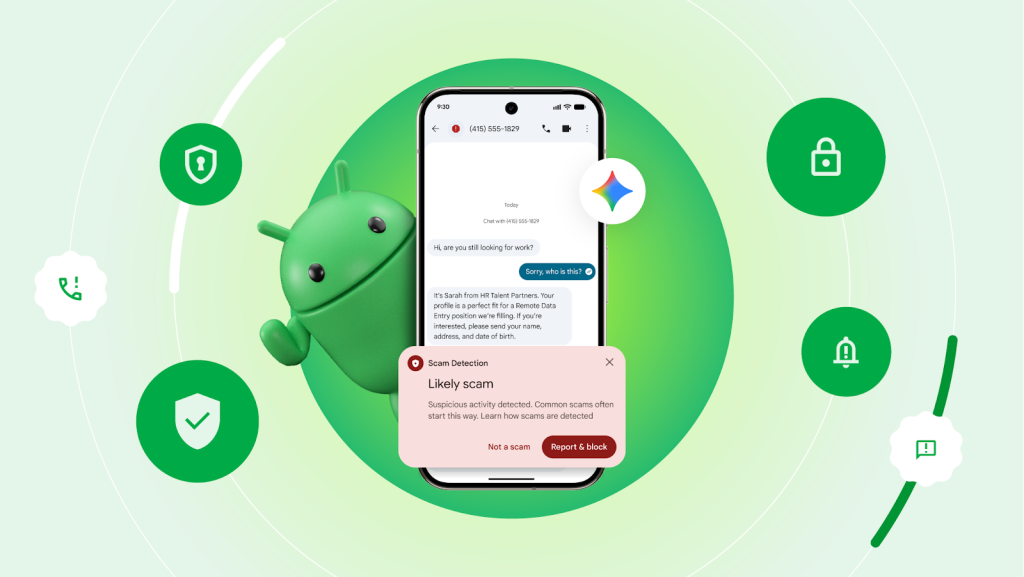
Mobile scams are growing increasingly sophisticated, blending stolen personal data with manipulative psychological tactics. However, Google is aggressively expanding its countermeasures, leveraging artificial intelligence to protect users from over 10 billion suspected malicious calls and messages every single month.
In a recent security update, Google detailed how it is deploying its Gemini on-device AI model to spot complex scams in real-time, expanding these protections to more global regions and flagship devices like the Samsung Galaxy S26.
Google shared the story of Majik B., an IT professional based in Sunnyvale, California. Majik received a call that spoofed his bank’s phone number. The caller knew his name, knew his address, and presented a highly plausible story about a “suspicious charge” on his account.
Despite his technical background, Majik was nearly tricked. “I’m usually pretty careful about this stuff,” he recalled, “but I stayed on the line longer than I normally would. Even knowing how these scams work, it was convincing in the moment”.
The attack was thwarted only when his phone displayed a real-time Scam Detection warning, prompting him to hang up and verify the account status directly through his banking app. As Majik noted, “The warning is what made me pause and avoid a bad situation”.
Google’s Scam Detection for phone calls analyzes conversations for speech patterns commonly associated with fraud. Initially available on Google Pixel devices across the U.S., UK, Canada, Australia, India, and Ireland, the feature is now rolling out to other manufacturers, beginning with the Samsung Galaxy S26 series in the U.S..
A critical component of this feature is its privacy-first architecture. Powered by Gemini’s on-device model, the audio processing happens entirely locally. Google notes that the conversation is never stored on the device or shared externally. Furthermore, the feature remains turned off by default, ensuring users retain total control over their privacy preferences.
Text-based scams are also getting an AI-powered security upgrade. Scam Detection for Google Messages is expanding to over 20 countries, bringing support for languages including Arabic, English, French, German, Portuguese, and Spanish.
For users with the latest flagship devices in the U.S., Canada, and the UK—including the upcoming Pixel 10 series and the Galaxy S26 series—Google is deploying the Gemini on-device model directly into the messaging app. This allows the system to analyze subtle conversational cues to detect sophisticated, long-term manipulation tactics.
This is particularly crucial for combating “pig butchering” (romance baiting) and fake job offers. Because these scams rely on gradually building trust over time rather than exhibiting immediate red flags, they require the advanced nuance of local AI models to catch at scale.
A recent evaluation by Counterpoint Research recognized Android as providing the most comprehensive AI-powered protections of any mobile platform. With these new Gemini integrations, Google aims to maintain that standard against an evolving threat landscape.
Support Our Threat Intelligence
Find our tech and OS security coverage helpful? Support our work today and unlock a 100% ad-free reading experience!
 Buy Me a Coffee
