Live from Your Webcam: Remcos RAT Evolves into a Real-Time Surveillance Nightmare
 Do Son
Remcos, once a commercial remote management tool turned notorious Remote Access Trojan (RAT), has received an upgrade. A new analysis published by security researchers at Point Wild reveals that the latest variants of Remcos have fundamentally shifted their operational playbook, abandoning local data storage in favor of immediate, real-time espionage.
The malware, which typically infects systems via phishing emails or compromised websites, is now designed to turn victims’ machines into live broadcasting stations for cybercriminals.
Historically, Remcos and similar RATs would quietly collect keystrokes, screenshots, and passwords, store them in hidden files on the victim’s hard drive, and exfiltrate them later. The Point Wild analysis highlights that this is no longer the case.
“Instead of stealing and storing data locally on the infected system, this variant establishes direct online command-and-control (C2) communication, enabling real-time access and control,” the report states.
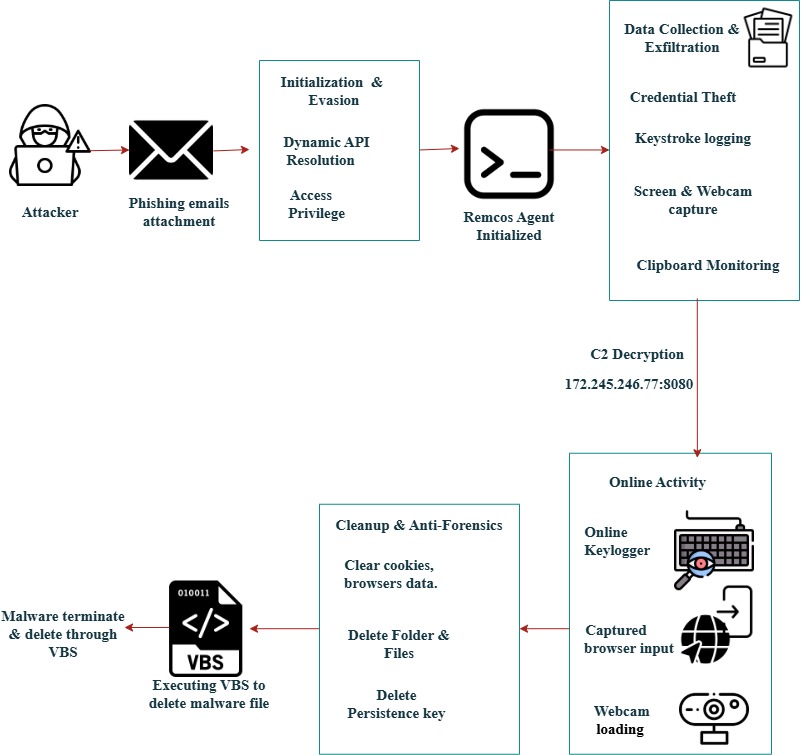
This evolution makes the malware exceptionally dangerous. Attackers are no longer waiting to download logs; they are watching victims live. “In particular, it leverages the webcam to capture live video streams, allowing attackers to monitor targets remotely,” the researchers warn. “This shift from local data exfiltration to live, online surveillance represents an evolution in Remcos’ capabilities, increasing the risk of immediate espionage and persistent monitoring”.
To keep this live stream of stolen data flowing, the Remcos developers have heavily invested in evasion techniques. The malware actively hides its capabilities from antivirus software by obfuscating its internal workings.
“APIs are decrypted at runtime to evade static detection, hinder reverse engineering, and dynamically resolve malicious functionality during execution,” the Point Wild analysis details.
Furthermore, Remcos hides its command-and-control server destination. It doesn’t store the C2 IP address in plain text; instead, it uses a byte-wise XOR decryption loop to reconstruct the address directly in the system’s memory right before it makes a network call.
The malware’s webcam capabilities are also modular. To keep its initial file size small and unsuspicious, Remcos doesn’t carry the webcam code with it. Instead, upon receiving a command from the attacker, it downloads a specific Dynamic Link Library (DLL) payload from the C2 server directly into memory to initialize the video capture device and encode the video stream.
Perhaps the most frustrating aspect for incident responders is how meticulously the new Remcos variant cleans up its own crime scene.
After stealing credentials and streaming data, the malware initiates an aggressive anti-forensics routine. “This tactic removes traces of its activity, disrupts forensic analysis, and diminishes evidence of credential theft or session hijacking,” the report explains.
The cleanup involves:
- Deleting browser cookies and stored browsing data.
- Deleting all temporary recording files (keylogging, screenshots, and audio recordings).
- Removing its own persistence registry keys (like the Rmc-GSEGIF mutex).
- Generating a temporary Visual Basic script (update.vbs) that deletes the original malware executable while the script is running, effectively making the malware vanish into thin air.
Despite these advanced evasion tactics, the threat can be neutralized if detected promptly. The researchers note that security tools like UltraAV currently detect this highly evasive variant under the signature Trojan.W32.111125.Remcos.YR.
To remediate an infection, experts advise victims to reboot their machines into Safe Mode with Networking to severe the live C2 connection before running a comprehensive antivirus sweep to delete the malicious files.
Related Posts:
- Pixel Phone Turns into Webcam for Nintendo Switch 2 via USB, No Accessory Needed
- Wrapped in Stealth: Python RAT Hides Inside ELF Binary to Evade Detection
- Stealthy Remcos RAT Campaign Uses PowerShell to Evade Antivirus Detection
- Stealthy REMCOS Backdoor Delivered by LNK Files: Bypasses Antivirus with Multi-Stage PowerShell Attack
Support Our Threat Intelligence
Find our threat intelligence and malware analysis helpful? Support our work today and unlock a 100% ad-free reading experience!
 Buy Me a Coffee
