 Do Son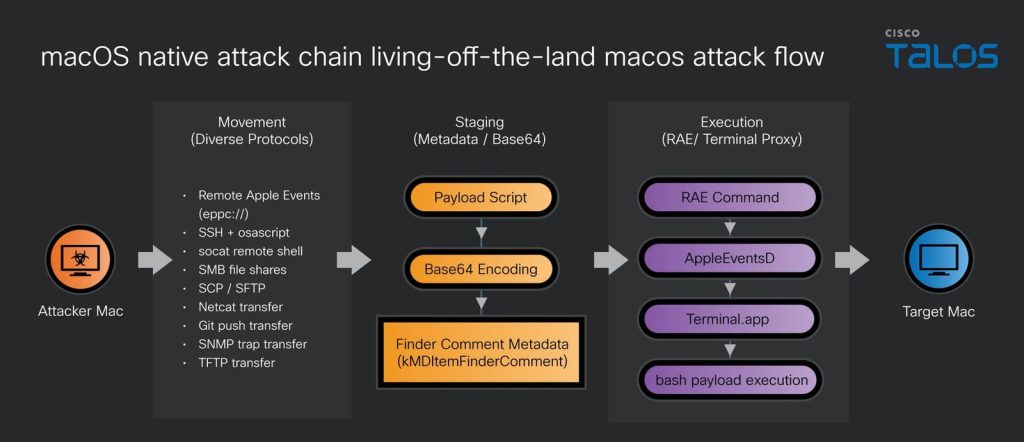
macOS living-off-the-land (LOTL) attack flow | Image: Cisco Talos
As macOS adoption reaches record highs in the enterprise—now serving as the primary workstation for over 45 percent of organizations—the traditional “security through obscurity” narrative has been shattered. A new report from Cisco Talos reveals that Mac endpoints have become high-value gateways to source code repositories and cloud infrastructure, with attackers increasingly turning to native “living-off-the-land” (LOTL) techniques to stay under the radar.
The shift in macOS usage from creative departments to the desks of developers and DevOps engineers has fundamentally changed the risk profile of the OS. These machines now house the “keys to the kingdom,” including sensitive production credentials and access to CI/CD pipelines.
Talos researchers warn that while LOTL techniques are well-documented for Windows, the native features of macOS remain significantly under-documented, providing a perfect hiding place for sophisticated adversaries.
The report highlights how attackers can bypass traditional security controls by repurposing built-in macOS features that defenders often overlook.
- Stealthy Payload Staging: Adversaries can abuse Spotlight metadata (specifically Finder comments) to stage malicious payloads. This method is particularly effective because it “evades static file analysis” by hiding code where security tools rarely look.
- Remote Execution: Native features like Remote Application Scripting (RAS) are being repurposed for remote execution, allowing attackers to run commands without deploying external malware.
- Lateral Movement: Attackers can establish persistence and move toolkits across a network using built-in protocols such as SMB, Netcat, Git, TFTP, and SNMP. These operations can function “entirely outside the visibility of standard SSH-based telemetry”.
In one technical demonstration, researchers showed how the Simple Network Management Protocol (SNMP) can be weaponized for file transfers. By using snmptrap, an attacker can send fragmented file data to a target machine where it is reassembled intact, verified by matching MD5 hashes. Similarly, the socat utility can handle both remote command execution and tool transfers by injecting “heredocs” through an interactive bash session.
The Talos report makes it clear that relying on static file scanning is no longer sufficient for modern macOS environments. To counter LOTL threats, the report offers several critical recommendations:
- Monitor Process Lineage: Shift focus toward identifying anomalies in how processes are created and interact.
- IPC Anomaly Detection: Watch for unusual inter-process communication that could signal a hijacked native service.
- Strict MDM Policies: Use Mobile Device Management to “disable unnecessary administrative services” and reduce the available attack surface.
Support Our Threat Intelligence
Find our threat intelligence and malware analysis helpful? Support our work today and unlock a 100% ad-free reading experience!
 Buy Me a Coffee
