Public PoC Exploits macOS DesktopServicesHelper for Root With No User Interaction
 Do Son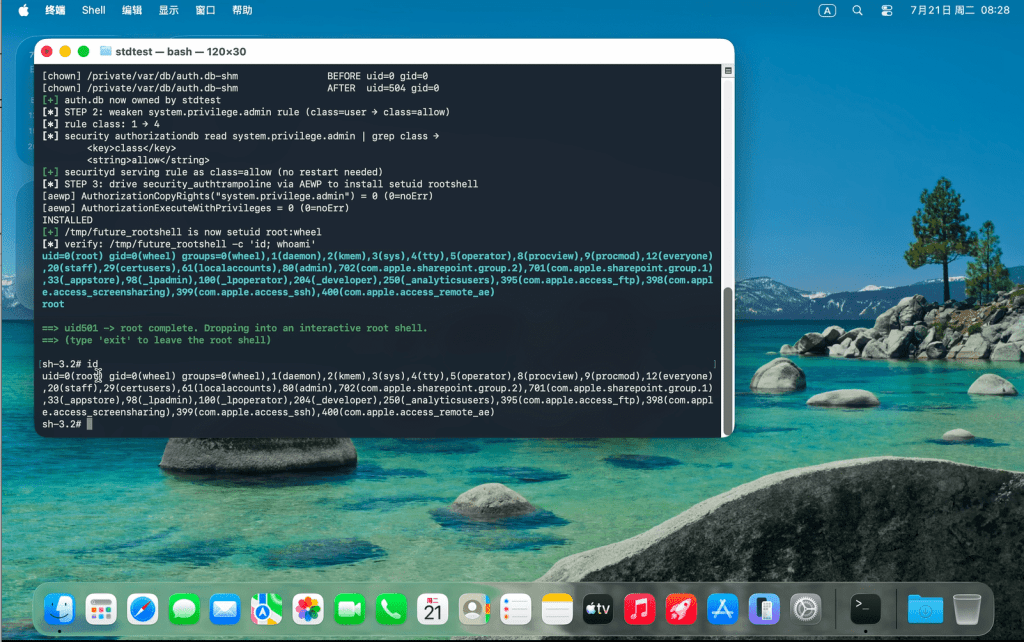
TL;DR
A researcher has published full details and a working proof-of-concept for a macOS privilege escalation bug. It turns an unprivileged user into root in about two seconds, with no user interaction and no password prompt. Apple fixed the flaw in macOS 26.6, yet assigned no CVE.
Why it matters
Local privilege escalation flaws let attackers finish a break-in. Malware that lands as a normal user can use this bug to seize full control. Here, the reward is a root shell with no prompt at all. Because a public PoC now exists, the bar to abuse is low on unpatched Macs. An attacker needs only local code execution to start. No phishing, clicks, or passwords are required.
The disclosure stands out for another reason. The finder says an autonomous agent discovered and verified the chain, then reported it to Apple within the same day.
How the attack works
This macOS privilege escalation is a composition flaw. Two system components are each fine alone but dangerous together. First, DesktopServicesHelper exposes a routine meant to repair iCloud file ownership. It changes ownership of caller-supplied files without checking their location and without any entitlement.
Its only guard assumes that any “sandboxed” caller is a trusted Apple app. An ordinary process can satisfy that assumption. As the writeup puts it, the two parts are “correct in isolation but dangerous in composition.” An attacker uses the routine to take ownership of the system authorization database. Then securityd, which reads that database live, trusts the new owner. A rewritten rule tells macOS to grant admin rights on its own. That yields root without a single click. The lesson is about trust between components. Each piece trusts an assumption the other never guarantees.
Affected versions and exploitation status
The macOS privilege escalation affects builds before macOS 26.6. The researcher verified it on macOS 26.5.2 on Apple Silicon, with System Integrity Protection enabled. No in-the-wild exploitation has been reported. However, a full public proof-of-concept is now available.
Patch and mitigation
Update to macOS 26.6, which contains the fix. Notably, Apple’s advisory lists only a related Gatekeeper bypass. So this specific flaw is not enumerated and carries no CVE. Admins should still treat 26.6 as security-critical and roll it out quickly. For the technical write-up and the public proof-of-concept, see the researcher’s GitHub repository.
Support Our Threat Intelligence
Find our vulnerability reports and weekly recaps helpful? Support our work today and unlock a 100% ad-free reading experience!
 Buy Me a Coffee
