 Do Son

At a Glance
| Malware Family | Unattributed .NET stager, GitHub C2 loader, Chrome data thief, and Telegram bot tool |
|---|---|
| Threat Actor | Unattributed crew (no proven tie to North Korean or Iranian groups) |
| Targets or Victims | Windows .NET coders applying for jobs and paid crypto tasks |
| Delivery Vector | 13 malicious NuGet packages, fake job assessments on GitHub, six npm packages, and a fake wallet app |
| Key Capabilities | Build-time MSBuild hooks, DLL side-loading via osk.exe, GitHub C2, and Chrome login theft |
TL;DR
Socket found 13 malicious NuGet packages tied to fake job assessments aimed at Windows .NET coders. Building or running the test apps staged DLL side-load files or pulled remote payloads from GitHub. NuGet pulled 12 packages, while one button tool stayed live with about 160 downloads.
Delivery: Fake Coding Tests and Poisoned Controls
From July 23 to November 4, 2026, four NuGet accounts pushed 13 malicious NuGet packages across 28 builds. According to Socket’s report on the NuGet campaign, most packages posed as WinUI 3 or WPF buttons. Earlier in July 2026, Amazon Inspector and OSV also flagged six linked npm packages from the same crew.
The newest lure was a public GitHub repo posing as a WinUI 3 take-home test. It asked job seekers to style a file list on Windows with Visual Studio 2026. The rules even warned coders: “Do not alter the inner workings or styles of the external FileButton itself.” That rule kept staff from checking the hidden hook inside the button.
Multi-Path Lures Beyond NuGet
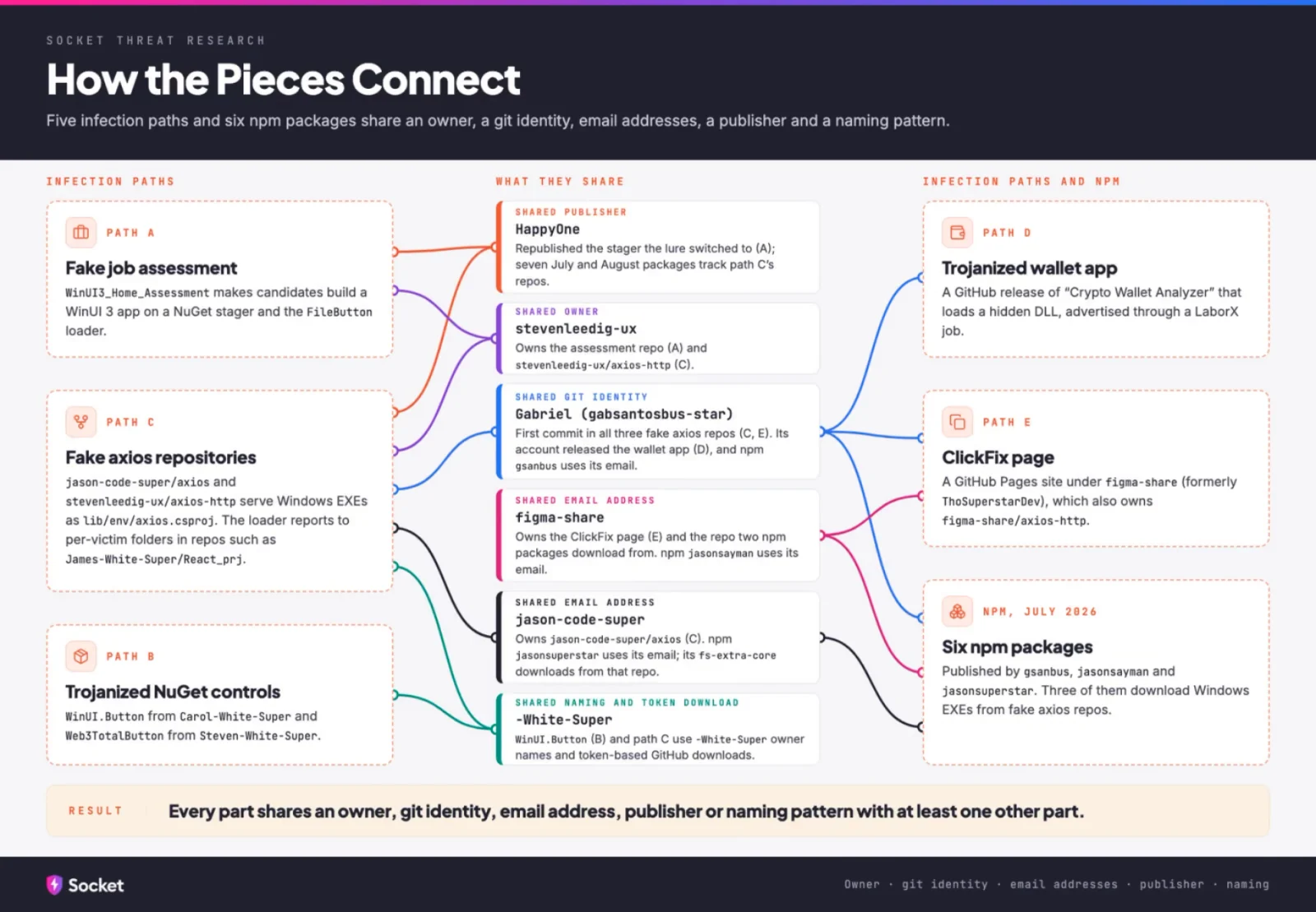
This wave did not stop at NuGet. In fact, Socket linked five attack paths to one crew. Besides fake job assessments, the group used fake axios repos, a ClickFix web page, and a fake “Crypto Wallet Analyzer” app.
For the wallet app, the crew posted an $8,500 to $10,000 job on LaborX in November 2026. Meanwhile, the WinUI.Button package stayed live with about 160 downloads. Socket noted that download counts include mirrors and bots, so they do not show real victim numbers.
Infection Chain: From Build to Side-Loading
Socket explained how the test works: “Neither package works alone. The build-time package only stages files, and the runtime control only launches a file that must already exist.” The chain runs in four clear steps when a coder builds and runs the app.
- Local Feed Restore: The project file tells NuGet to pull two poisoned packages from a local folder or web feed.
- Build-Time Hook: An MSBuild targets file runs a hidden DLL after each build and hides errors from the user.
- File Staging: Next, that DLL pulls a remote file to a local folder and copies the Windows On-Screen Keyboard (osk.exe) next to it.
- Runtime Launch: When the app opens, the FileButton control starts the copied osk.exe to run the side-loaded DLL.
HijackLibs lists osk.exe and OskSupport.dll as a known Windows DLL side-load pair. Separately, WinUI.Button skips build hooks and pulls a payload straight from its button code. After NuGet deleted the first account’s files, the crew pushed them again under a new account and updated the repo.
Command-and-Control and Data-Exfiltration Behaviour
Most command-and-control (C2) and data theft ran over GitHub and Telegram instead of custom servers. In fake axios repos, the crew hid Windows apps inside files named like C# project files. Before any web calls, the main loader checked for low RAM, virtual machines, and lab tools.
Once clear, the loader used a built-in GitHub token to make a victim folder and post host details. Then it checked GitHub for a locked payload, decoded it in RAM, and wiped itself. Other tools included a Python Chrome stealer using Volume Shadow Copies for logins and a tool that sent host data to Telegram.
Confirmed Ties Versus Unconfirmed Attribution
Socket confirmed that all five paths share one crew via GitHub owners, emails, and names. However, ties to a named threat group remain unconfirmed. Although fake job assessments look like North Korean Contagious Interview lures, Socket saw no shared code or malware. As Dark Reading noted, many state and crime crews now use Visual Studio lures and GitHub C2.
Defense and Detection Guidance
Coders must treat every take-home coding test as untrusted code. Before you build a repo, check project files for local NuGet feeds, bundled packages, and odd controls. Always build and test fake job assessments inside a clean virtual machine with no saved logins.
Teams should turn on NuGet source mapping and check third-party build files for shell calls. Finally, defenders should watch for osk.exe outside System32, .NET apps dropping files in temp folders, and odd GitHub API or Telegram traffic.
Support Our Threat Intelligence
Find our threat intelligence and malware analysis helpful? Support our work today and unlock a 100% ad-free reading experience!
 Buy Me a Coffee
