The “Accidental” Breach: How a Misconfigured Endpoint Led to a Major SharePoint Data Leak
 Do Son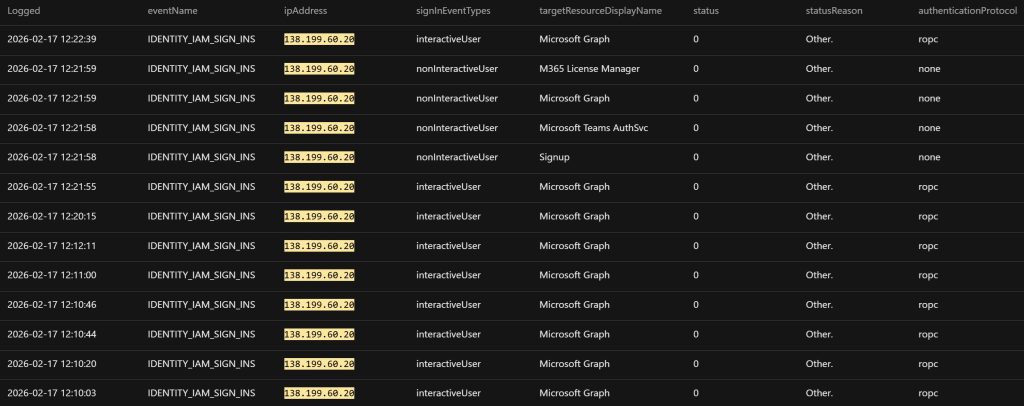
Successful authentications | Image: Trend Micro
A recent investigation by Trend Micro has revealed a case study where a devastating data exfiltration incident was triggered not by advanced malware, but by a simple misconfigurations and poor credential hygiene.
The attack began with a simple discovery: an exposed Spring Boot Actuator endpoint. While Spring Boot is a popular framework for building web apps, its Actuator module is designed to show operational information—data that should never be public.
In this case, the /env and /configprops endpoints were left wide open. While no passwords were shown in plaintext initially, the /configprops endpoint “exposed valuable information, including a configuration block related to SharePoint integration”. This gave the attackers a roadmap, revealing the exact username of a SharePoint service account and the host URL.
The second link in the chain was a classic security blunder: plaintext secrets stored in a spreadsheet.
During the investigation, analysts found a file containing client IDs and client secrets for an internal Azure AD application. As the report notes, “Application secrets function similarly to passwords: anyone who possesses the client ID and client secret of an application can attempt to authenticate”. By documenting these credentials informally for convenience, the organization inadvertently handed the attackers the keys to the kingdom.
With the service account name from the Actuator and the client secret from the spreadsheet, the attackers turned to a risky authentication method: Resource Owner Password Credentials (ROPC).
ROPC is a legacy flow that allows an application to sign in a user by directly handling their password, bypassing modern security challenges like Multi-Factor Authentication (MFA). “If threat actors obtain credentials, they can often authenticate access without triggering additional security challenges”. Using a trial-and-error approach, the attackers successfully requested an access token from Azure AD, which they then used to pivot toward SharePoint Online.
The final stage of the attack was entirely “malware-less.” Using the stolen token, the threat actor simply used valid API access to interact with SharePoint resources.
Logs revealed a flurry of activity: document libraries were enumerated and sensitive files—including Mail.sql, Credential.txt, and VPN_Exception.xlsx—were downloaded and exfiltrated. “The attacker simply used valid credentials and API access,” proving that the most dangerous intruder is the one who looks like a legitimate user.
To prevent a repeat of this scenario, security teams are urged to move beyond perimeter defense and focus on Cyber Risk Exposure Management (CREM). Key recommendations include:
- Restrict Actuator Access: Ensure endpoints like /env are never publicly accessible; use IP allowlists or require valid authentication.
- Audit for Plaintext Secrets: Scour the environment for credentials hidden in spreadsheets, shared drives, or configuration files.
- Kill the ROPC Flow: If ROPC isn’t strictly required, disable it in favor of modern, MFA-enforced authentication.
Support Our Threat Intelligence
Find our threat intelligence and malware analysis helpful? Support our work today and unlock a 100% ad-free reading experience!
 Buy Me a Coffee
