 Do Son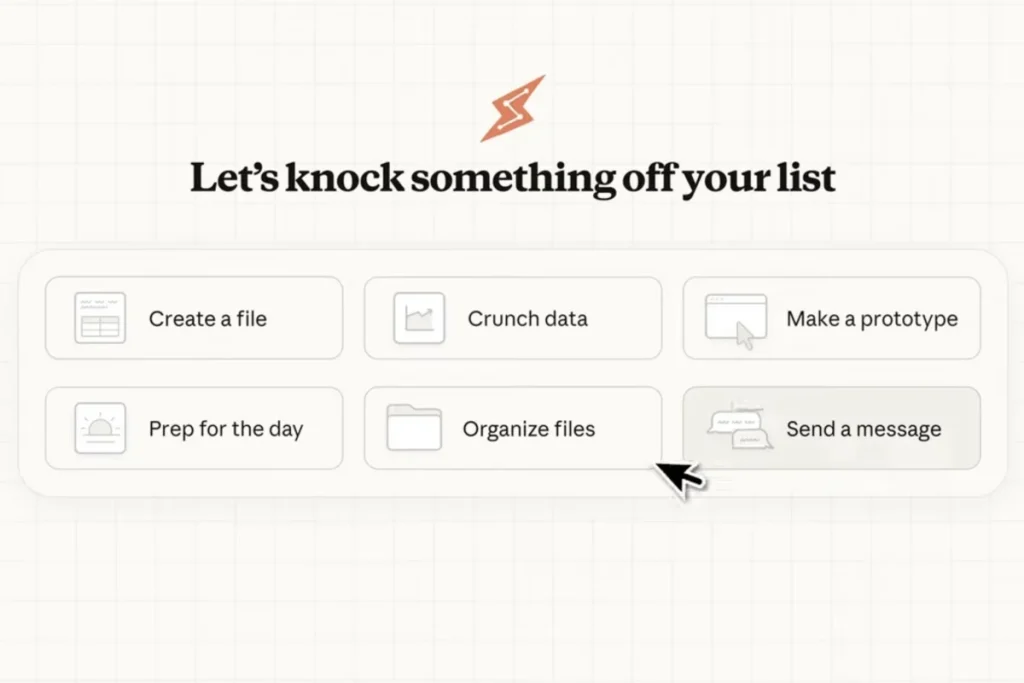
Following the 2024 debut of “Claude Code”—a coding agent that became an immediate favorite among developers—AI powerhouse Anthropic has finally democratized its “computer use” capabilities for the general populace. Today, Anthropic unveiled “Claude Cowork,” a novel preview feature positioned as an autonomous assistant for file management and automation. This enables non-technical users to utilize simple natural language to command Claude to organize directories, process financial receipts, or even navigate the web directly on a Mac.
The quintessential concept behind Claude Cowork is the extension of AI prowess from the confines of a chat interface into the user’s local hardware. Anthropic describes it as a “simplified version of Claude for everyone.” Its operation is intuitive: once authorized to access specific folders, the AI can read, edit, or generate new files within that designated environment.
Anthropic highlighted several pragmatic applications for this technology:
- Automated Directory Organization: Users can command Claude to scan a chaotic downloads folder and autonomously rename files based on their content (e.g., transforming “IMG_1234.jpg” into “2026_CES_Exhibition_Photo.jpg”) to enhance discoverability.
- Financial Data Extraction: By providing a collection of invoice or receipt screenshots, Claude can recognize the data and synthesize an Excel spreadsheet to track expenditures.
- Inter-application Orchestration: When paired with the Claude Chrome extension, Cowork can navigate the web or interface with third-party applications like Canva through its “Connectors” framework.
Anthropic emphasized that Cowork supports asynchronous workflows, allowing users to queue multiple tasks simultaneously without awaiting the completion of prior instructions. Notwithstanding its convenience, granting an AI the authority to modify local files entails inherent risks. Anthropic conceded that Claude Cowork possesses “potential for disruption,” such as the inadvertent deletion of vital files or the misinterpretation of user intent.
To alleviate security concerns, the company underscored that Claude remains incapable of accessing or modifying content beyond explicitly authorized boundaries—restricting its activity to a predefined “sandbox.” Nevertheless, Anthropic advises users to provide “highly precise” instructions to prevent unintended outcomes. Currently in a preview phase, Claude Cowork remains exclusive to “Claude Max” subscribers and requires the macOS application, while other users are relegated to a waitlist.
This strategic maneuver illustrates Anthropic’s ambition to transition “Agentic AI” from a developer’s niche utility into a mainstream productivity engine. While Microsoft has promoted Copilot for three years, its attempts to facilitate direct computer manipulation have been hampered by accuracy and privacy anxieties. Conversely, Anthropic has cultivated significant trust within the engineering community via Claude Code, a reputation it is now leveraging to penetrate the consumer market. Should Claude Cowork demonstrate stability in managing tedious tasks like file organization and format conversion, it may become the most sophisticated desktop assistant to date—though the psychological threshold for allowing an AI to delete local data remains a formidable barrier.
Related Posts:
- A New AI Frontier: Claude’s Chrome Extension Opens the Door to New Dangers
- Beyond the Terminal: Anthropic Launches a Web-Based Editor for Claude Code
- Anthropic Report: Criminals Are Weaponizing AI to Automate Cyberattacks at Scale
- Microsoft Copilot to Be Powered by Two AIs: OpenAI and Now Anthropic
- Claude AI Integrates with Google Workspace
Support Our Threat Intelligence
Find our tech and OS security coverage helpful? Support our work today and unlock a 100% ad-free reading experience!
 Buy Me a Coffee
