Fileless Python Malware Uses Humanitarian Lures to Deploy Full-Spectrum Surveillance
 Do Son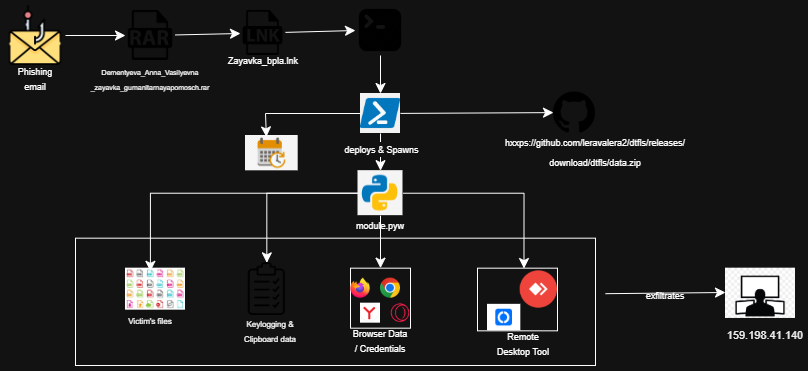
Infection chain | Image: CRIL
According to the latest intelligence from Cyble Research and Intelligence Labs (CRIL), threat actors are actively demonstrating how to turn a victim’s empathy against them, deploying a sophisticated cyberespionage campaign that pairs human manipulation with highly disciplined, stealthy infrastructure.
By exploiting trusted cloud services and utilizing a fileless execution chain, this unknown adversary is quietly deploying full-spectrum surveillance platforms while leaving almost zero operational footprint.
The campaign relies heavily on the human element, specifically targeting Russian-speaking individuals through highly relevant social engineering. The threat actors are not relying on generic invoices or fake shipping notifications; instead, they are using the guise of humanitarian assistance.
As the CRIL researchers note, “The attack is delivered via phishing emails containing a malicious LNK file disguised within a RAR archive, using a Russian humanitarian aid request form to exploit contextual trust”.
When a victim attempts to open what they believe is an application form, the infection chain is triggered. To keep the victim entirely unaware, the malware immediately displays a decoy document. While the user is reading the fake form, a heavily obfuscated, PE-less (fileless) Python implant is silently deployed in the background.
Once the initial execution occurs, the malware must fetch its primary payload. This is where the campaign demonstrates its technical maturity. Rather than reaching out to an easily blockable, newly registered malicious domain, the attackers leverage the trust inherently placed in developer platforms.
“The payload is retrieved from GitHub Releases, enabling the attacker to blend malicious traffic with legitimate services and evade traditional detection mechanisms,” the report states. For a network defender or automated firewall, blocking GitHub is rarely an option, making this a highly effective evasion tactic.
Furthermore, the operators are utilizing PyArmor v9.2 Pro to obfuscate the Python payload, drastically complicating reverse engineering efforts, and routing their data through a custom Flask command-and-control (C2) panel. To ensure they do not lose access upon system reboot, the malware establishes persistence by quietly writing scheduled tasks.
Once entrenched, the implant transforms the infected machine into a live intelligence asset. The campaign is designed for continuous, resilient surveillance.
The capabilities of the payload are devastating for both personal privacy and corporate security. According to the analysis, “The Python implant goes beyond credential collection. It enables the attacker to monitor every action a victim takes, collect active browser sessions, capture communications, and maintain live remote desktop access”.
In addition to live desktop viewing, the malware systematically logs keystrokes, harvests clipboard data, captures screenshots, and exfiltrates sensitive files directly back to the attackers.
While attribution remains inconclusive, the precision of the operation—ranging from the PyArmor obfuscation to the GitHub staging—indicates a highly skilled and operationally disciplined threat actor. The recent introduction of secondary, survey-based lures also suggests this campaign is in active, ongoing development.
Support Our Threat Intelligence
Find our threat intelligence and malware analysis helpful? Support our work today and unlock a 100% ad-free reading experience!
 Buy Me a Coffee
