Massive Smishing Error524 Campaign Evades Traditional Security Filters Worldwide
 Do Son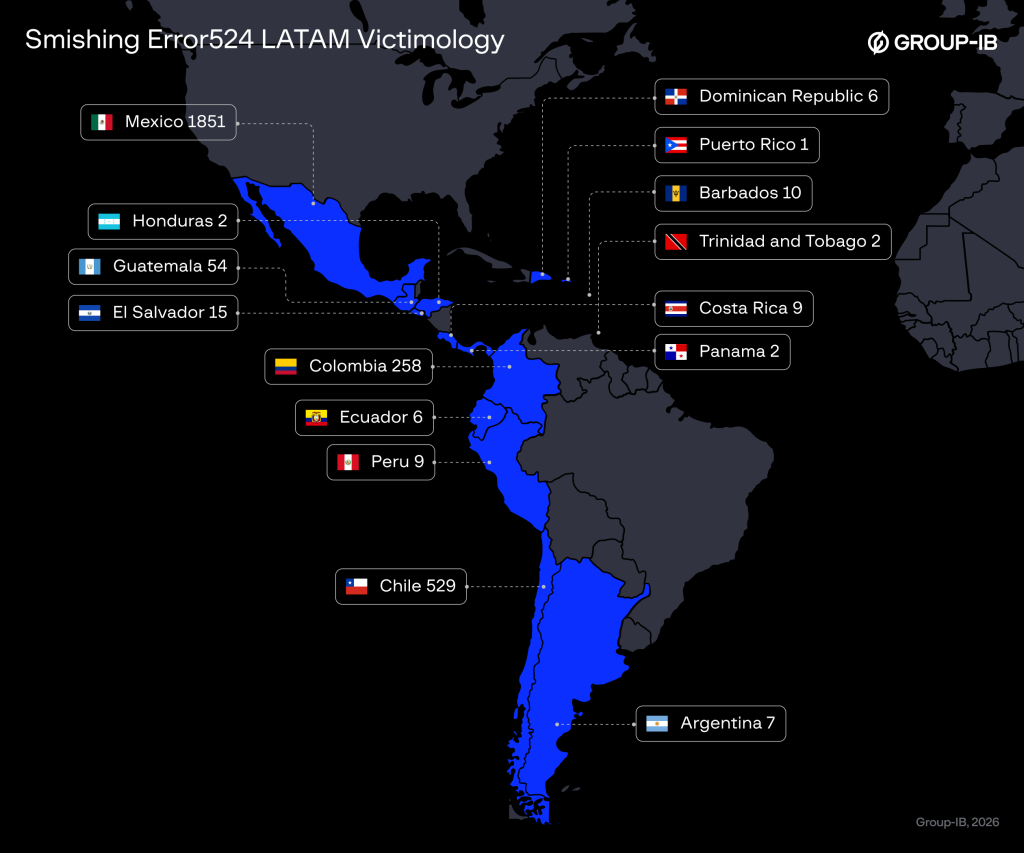
Breakdown of the smishing campaign’s LATAM footprint | Image: Group-IB
Overview of the Global Fraud Threat
Cybercriminals are constantly finding new ways to bypass modern security defenses. Recently, security researchers uncovered a massive fraud operation that exploits millions of mobile users worldwide. This highly sophisticated Smishing Error524 campaign marks a dangerous evolution in criminal tactics. Specifically, the malicious actors use legitimate web infrastructure aesthetics to hide their malicious intent. Therefore, standard security filters struggle to detect this global threat. According to a comprehensive Group-IB phishing report, the operation has already spread to dozens of countries. Consequently, organizations must understand how this evasion blueprint works to protect their customers.
The Global Scope of the Fraud Operation
The fraudulent operation originally started in Latin America during the second half of 2025. However, this new Group-IB phishing report confirms that the infrastructure now spans 72 countries across the globe. For instance, the campaign has successfully impersonated more than 267 unique brands. Specifically, these targets span critical industries like telecommunications and financial services.
Furthermore, automated clustering tools identified exactly 4,389 unique phishing domain instances during the investigation. Within Latin America, Mexico remains the most heavily targeted country with 1,851 domains. Meanwhile, Chile and Colombia follow closely behind as top regional targets.
The Deceptive Cloudflare Evasion Blueprint
The most dangerous aspect of this operation involves its clever anti-analysis architecture. Specifically, the threat actors use fake Cloudflare error screens to deceive automated scanners. If an unauthorized user attempts to analyze the website, the server displays a fake gateway timeout page.
As noted in the official report text:
“The most operationally significant feature of this campaign is its layered anti-analysis architecture, centered on exploiting legitimate Cloudflare error page aesthetics as a deception mechanism.”
Therefore, automated crawlers see absolutely no malicious scripts or brand assets. Consequently, the active Smishing Error524 campaign safely maintains its operational longevity.
How the Dual-Layer Geofencing Works
To achieve this level of stealth, the phishing kit utilizes client-side IP geolocation queries. When a user clicks the link, the backend checks their specific country and language. Therefore, the malicious application only renders if the visitor matches precise target rules.
For example, the system explicitly filters out desktop users by verifying mobile user-agent strings. If the request comes from an unwanted IP address, the system drops them onto a fake error screen. Thus, the deceptive infrastructure avoids traditional detection methods with ease.
Dissecting the 5-Stage Attack Chain
From Local SMS Lures to Initial Exploitation
When a qualifying victim interacts with the platform, a precisely engineered interaction flow unfolds. First, the victim receives an SMS message that appears to come from a local number. This initial text message uses an urgency pretext, such as expiring loyalty rewards, to prompt an immediate click. Moreover, shortened URLs are utilized to obscure the real destination domain from mobile carriers.
The Obfuscated Single Page Application Flow
Once the victim clicks the link, the phishing kit loads a minimal HTML skeleton. This skeleton contains an obfuscated framework powered by Vue.js. Because the code is completely scrambled, traditional static analysis tools fail to spot any immediate red flags.
Next, the form asks for a national identification number to build false trust. Finally, the platform requests full credit card details, including the card number, expiration date, and CVV code.
Technical Infrastructure and Backend Exfiltration
The backend architecture relies heavily on modern web protocols to steal data efficiently. Instead of using traditional forms, the system establishes a secure, real-time connection. The Group-IB phishing report explains the exact mechanism:
“Data exfiltration occurs via encrypted WebSocket channels using binary encoded payloads, with heartbeat pings to maintain real-time connections.”
Consequently, data travels directly to the hackers over an upgraded connection. To mask their true origin servers, the criminals route traffic through Cloudflare proxies. However, approximately 30% of the actual backend hosting relies on Tencent Cloud and Alibaba Cloud. Furthermore, the attackers use cheap, short-lived top-level domains like .ink and .bond to cycle through assets rapidly.
Summary of Defensive Strategies
Ultimately, this complex operation shows how modern eCrime syndicates have industrialized brand impersonation. Organizations cannot rely solely on basic domain takedowns to protect their digital assets. This is because the active Smishing Error524 campaign can quickly re-front under a new domain name. Instead, staying ahead of these threat groups requires a proactive combination of real-time threat intelligence and deep behavioral detection.
Support Our Threat Intelligence
Find our threat intelligence and malware analysis helpful? Support our work today and unlock a 100% ad-free reading experience!
 Buy Me a Coffee
