 Do Son
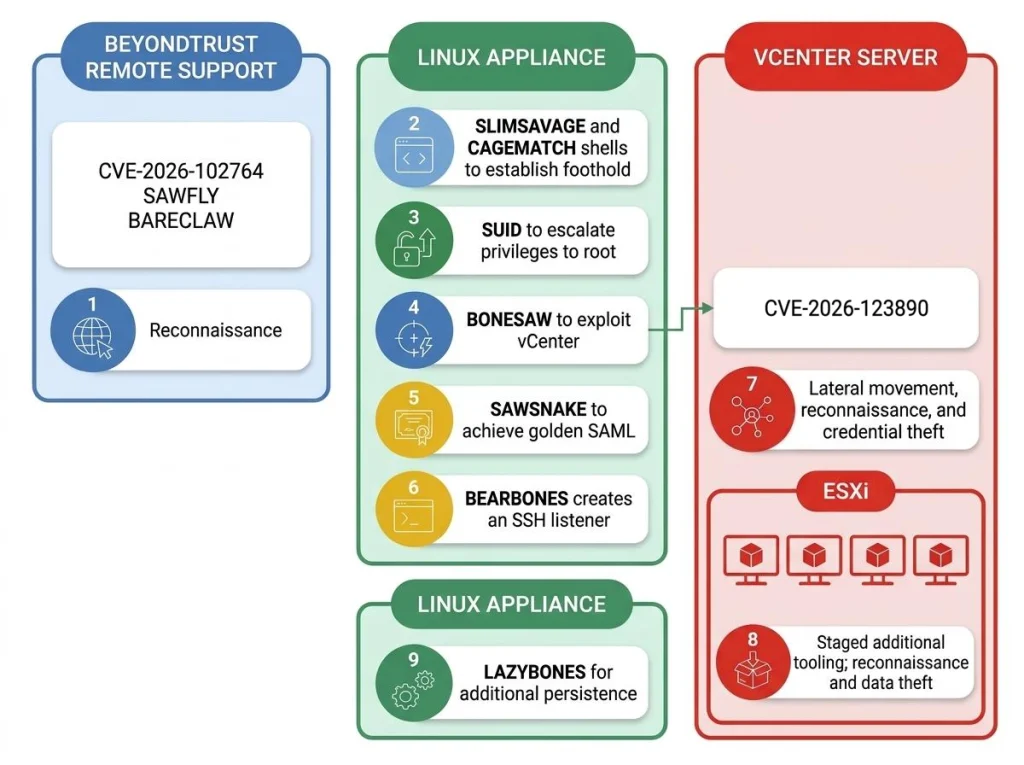
ARMORY CASTLE lateral movement and vCenter compromise sequence of events
TL;DR
A China-linked espionage group exploited a vCenter zero-day, CVE-2026-123890, in early September 2026. Mandiant and Google Threat Intelligence Group (GTIG) disclosed the attacks on November 19. Broadcom disclosed and patched the flaw on November 19. It scores CVSS 9.8 and lets an unauthenticated attacker gain administrator access to vCenter.
CVE-2026-123890 is an authentication bypass in the VMware Directory Service. ARMORY CASTLE, formerly tracked as UNC5221, used it through a custom tool called BONESAW. The tool created SSO admin accounts and stole vCenter secrets. Broadcom’s VMSA-2026-0009 fixes it, along with four other vCenter, SDDC Manager and Tools flaws.
- Total: 5 CVEs
- Severity: 1 Critical · 2 High · 2 Medium
- Actively exploited: 1 (exploited in the wild)
- Highest severity: 9.8 (Critical · CVSSv3) — CVE-2026-123890
- Action: Apply the latest security updates now
Notable CVEs
| CVE | CVSS (CVSSv3) | Type | Fixed in | Status |
|---|---|---|---|---|
| CVE-2026-123890 | 9.8 | vCenter authentication-bypass | 9.1.1.0200, 9.0.2.0200, 8.0 U3m (+1) | Exploited in the wild |
Why It Matters
Exploited Before Disclosure
This is a true vCenter zero-day. According to the Mandiant and GTIG report, “ARMORY CASTLE exploited this vulnerability in early September 2026 using BONESAW.” That was more than two months before Broadcom’s fix.
Moreover, the attackers may have held the bug even longer. BONESAW carries a build timestamp of July 13, 2026. Mandiant notes, however, that Go build metadata “can be modified prior to compilation.”
vCenter Controls the Whole Estate
vCenter manages every ESXi host and virtual machine in a vSphere environment. So an attacker who owns it can reach domain controllers and other critical servers. In this case, the group pulled Active Directory database files straight from guest VM disks.
Part of a Larger Campaign
The intrusion began with another zero-day. In October, Mandiant described ARMORY CASTLE exploiting CVE-2026-102764 in BeyondTrust Remote Support. CISA added that flaw to its Known Exploited Vulnerabilities catalog on October 16. Mandiant says the group used “two zero-days” and “three sets of malware” in a single compromise.
Who Is ARMORY CASTLE
GTIG attributes the activity to ARMORY CASTLE, a suspected PRC-nexus espionage actor. The group has exploited edge and security appliances since 2023. However, Mandiant calls BONESAW “a significant expansion into post-compromise use of zero-days.” The researchers also say the tool was “likely developed for broader operations,” so other victims may exist.
How the Attack Works
The Flaw
The Broadcom VMSA-2026-0009 advisory says “a malicious actor with network access to vCenter may exploit this issue to bypass authentication.” Mandiant adds more detail. The bug discloses a Secure Remote Password (SRP) session key over the directory service’s RPC interface on TCP port 2012. With that key, an attacker gets a session as administrator@vsphere.local without knowing any password.
Mandiant stresses that this is not the same as CVE-2026-59309, a vmdir LDAP flaw disclosed in July. In fact, BONESAW worked against a vCenter server “already patched against CVE-2026-59309.”
The Intrusion Chain
First, the group moved from the compromised Remote Support appliance to an internal Linux appliance without EDR. It then scanned for VMware services, including port 2012. Next, BONESAW abused the vCenter zero-day to copy the directory database. It also stole the SAML signing key and created an SSO administrator account.
After that, a second tool, SAWSNAKE, forged SAML tokens. This Golden SAML technique let the group “bypass MFA, and impersonate any user.” The attackers also enabled SSH on vCenter, stole its master key and PostgreSQL credentials, then switched SSH off again.
New Malware Families
- BONESAW: Go-based exploitation tool for CVE-2026-123890
- SAWSNAKE: Go utility for forging vCenter SAML logins
- BEARBONES: backdoored Dropbear SSH server that logs passwords
- SLIMSAVAGE and CAGEMATCH: JSP webshells for commands and file uploads
- LAZYBONES: Slack-based backdoor seen in an earlier ARMORY CASTLE intrusion
Affected Versions
CVE-2026-123890 affects vCenter in these releases:
- vCenter 9.1.x: fixed in 9.1.1.0200
- vCenter 9.0.x: fixed in 9.0.2.0200
- vCenter 8.0: fixed in 8.0 U3m
- vCenter 7.0: contact Broadcom Support if you have an extended support contract
- VMware Cloud Foundation 5.x: fixed in 5.2.5
- Telco Cloud Platform and Telco Cloud Infrastructure: see KB463116
The Other Four Flaws
VMSA-2026-0009 also fixes three SDDC Manager bugs reported by NATO NCSC. These are SQL injection CVE-2026-123891 (8.1), command injection CVE-2026-123892 (7.2) and privilege escalation CVE-2026-123893 (6.7). In addition, CVE-2026-123894 (6.7) is a SAML token signature bypass in VMware Tools for Windows. Broadcom does not report exploitation of these four.
Patch and Mitigation
Broadcom lists no workarounds, so patching is the only fix. Mandiant says it “strongly recommend[s] that affected organizations immediately apply the security patches.”
Hunt for This vCenter Zero-Day
- Restrict access to vCenter port 2012 to trusted management hosts only.
- Review SSO accounts for new administrators you did not create.
- Check VAMI logs for SSH being turned on and then off again.
- Look for SSH servers that announce “SSH-2.0-pulsesecure_23345” on high ports.
- Add EDR to internal Linux appliances, which this group targets.
If you find signs of compromise, rotate the vCenter STS signing certificate and all SSO credentials. Otherwise, forged SAML tokens may keep working after the patch.
Support Our Threat Intelligence
Find our vulnerability reports and weekly recaps helpful? Support our work today and unlock a 100% ad-free reading experience!
 Buy Me a Coffee
