 Do Son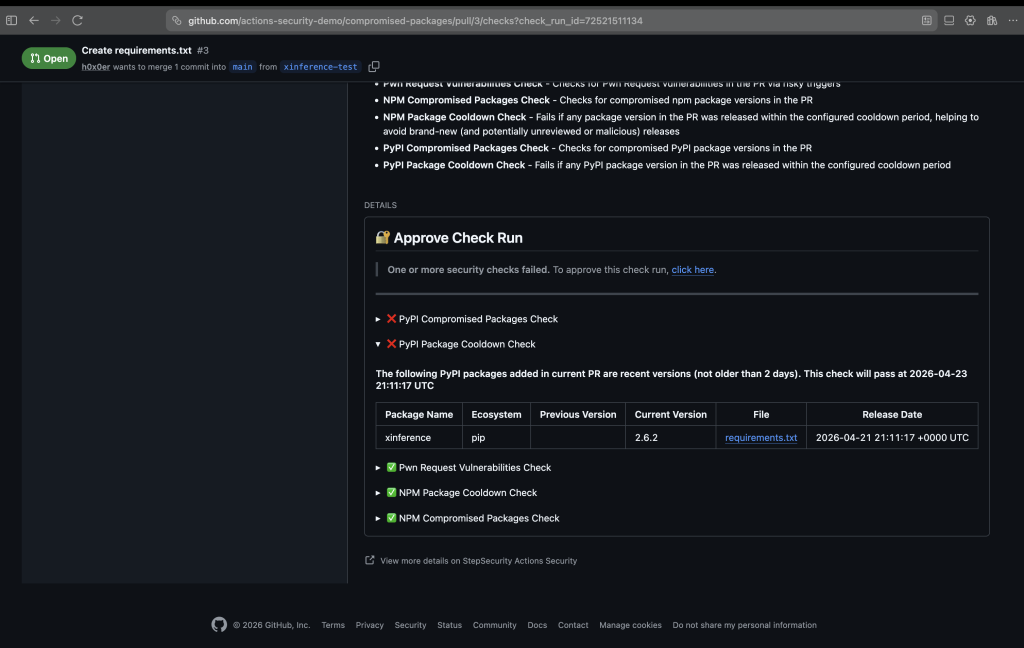
The Python ecosystem is reeling from a sophisticated supply chain attack targeting Xinference (Xorbits Inference), a widely used open-source framework for deploying Large Language Models (LLMs). On April 22, 2026, security researchers confirmed that three consecutive versions of the package—2.6.0, 2.6.1, and 2.6.2—were published to PyPI containing a potent, two-stage credential-stealing payload.
The attack has been attributed to the threat actor TeamPCP, the same group responsible for recent compromises of the litellm and telnyx packages.
Xinference is a cornerstone for many MLOps pipelines, supporting models like Llama, Mistral, and Qwen. This makes it a lucrative target for attackers. As noted in the report, “Environments running xinference typically hold elevated cloud credentials: GPU instance IAM roles, model registry tokens, object storage access keys, and Kubernetes service account tokens are all common in xinference deployment configurations.”
By compromising this framework, TeamPCP gained a direct line to highly sensitive enterprise infrastructure.
The campaign was characterized by its speed and iterative “live operational refinement”. The malware was injected into xinference/__init__.py, the package’s top-level module. Because Python executes this file on every import, the payload fires automatically whenever a developer runs import xinference or uses the CLI.
The attacker’s progression across the three versions shows a clear evolution in stealth:
- Version 2.6.0: The malicious code was placed at the module scope, making it relatively easy to spot in a code diff.
- Version 2.6.1: The attacker moved the code inside a legitimate helper function to hide it, but mistakenly made the execution synchronous, which could cause visible lag.
- Version 2.6.2: The final refinement moved the payload back to an asynchronous, detached subprocess hidden within a function—achieving both stealth and non-blocking execution.
Once triggered, the first stage decodes a second-stage “credential collector” that is piped directly into a fresh Python interpreter via stdin, ensuring the malicious script never touches the disk.
The collector is disturbingly thorough, targeting:
- Cloud Infrastructure: AWS (disk, environment, and live IMDS API calls), GCP, and Azure.
- Development Tools: SSH keys, Docker configs, npm/PyPI tokens, and Kubernetes service account tokens.
- Sensitive Files: A recursive walk (up to depth 6) through system directories for .env files, TLS/SSL private keys, and CI/CD configurations like terraform.tfvars.
- Crypto Wallets: Wallets for Bitcoin, Ethereum, Cardano, and Solana.
All stolen data is compressed into an archive named love.tar.gz and exfiltrated via a curl POST to the attacker-controlled domain whereisitat.lucyatemysuperbox.space.
While the malicious versions have been yanked from PyPI, any organization that installed Xinference on April 22 must take immediate action.
- Verify Version: Run pip show xinference. If the version is 2.6.0, 2.6.1, or 2.6.2, your system is compromised.
- Downgrade: Immediately run pip install “xinference<2.6.0”.
- Rotate Everything: You must rotate all cloud credentials, SSH keys, and API tokens accessible on the affected systems.
- Audit Secrets: Specifically, rotate AWS Secrets Manager and SSM Parameter Store values, as the collector was designed to fetch these live.
Support Our Threat Intelligence
Find our threat intelligence and malware analysis helpful? Support our work today and unlock a 100% ad-free reading experience!
 Buy Me a Coffee
