 Do Son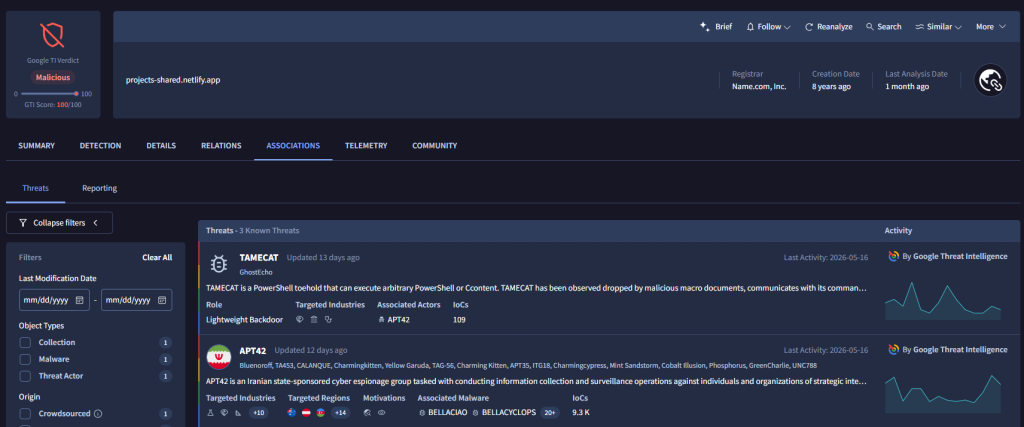
At a glance
| Actor or group | APT42 (Iran-linked; also tracked as TA453) |
| Activity type | AI-assisted spear-phishing, credential theft, TAMECAT backdoor delivery |
| Targets or victims | Defense and government figures, a US think tank, nuclear-energy sector contacts |
| Scale | Multiple hand-picked individuals; not mass phishing |
| Jurisdiction or law-enforcement status | Three linked IRGC operators charged in the US in 2024; reward of up to $10 million reported |
| Source | DarkAtlas research report |
TL;DR
APT42, an Iran-linked espionage group, has upgraded its TAMECAT backdoor and folded generative AI into its phishing playbook. A new report from DarkAtlas ties recent 2026 malware samples to the group with high confidence. The campaign focused on defense, government, and nuclear-energy targets.
Iran-linked group sharpens an old playbook
Researchers at DarkAtlas have tied a fresh wave of 2026 malware samples to APT42. This Iran-linked group runs targeted phishing and espionage operations. The report describes an upgraded TAMECAT backdoor and a growing role for generative AI. As DarkAtlas puts it, “APT42 continues to refine a familiar operating model.”
APT42 also goes by TA453 in some reporting. Its operators favor believable personas over noisy spam. They build trust across email and WhatsApp, sometimes over weeks. Then they steer victims toward credential theft or a malware chain.
What happened
The DarkAtlas team analyzed the APT42 TAMECAT malware across several 2026 samples. These included a PDF-themed Windows shortcut, a batch controller, and an obfuscated PowerShell module. Together, they form a probable TAMECAT delivery chain.
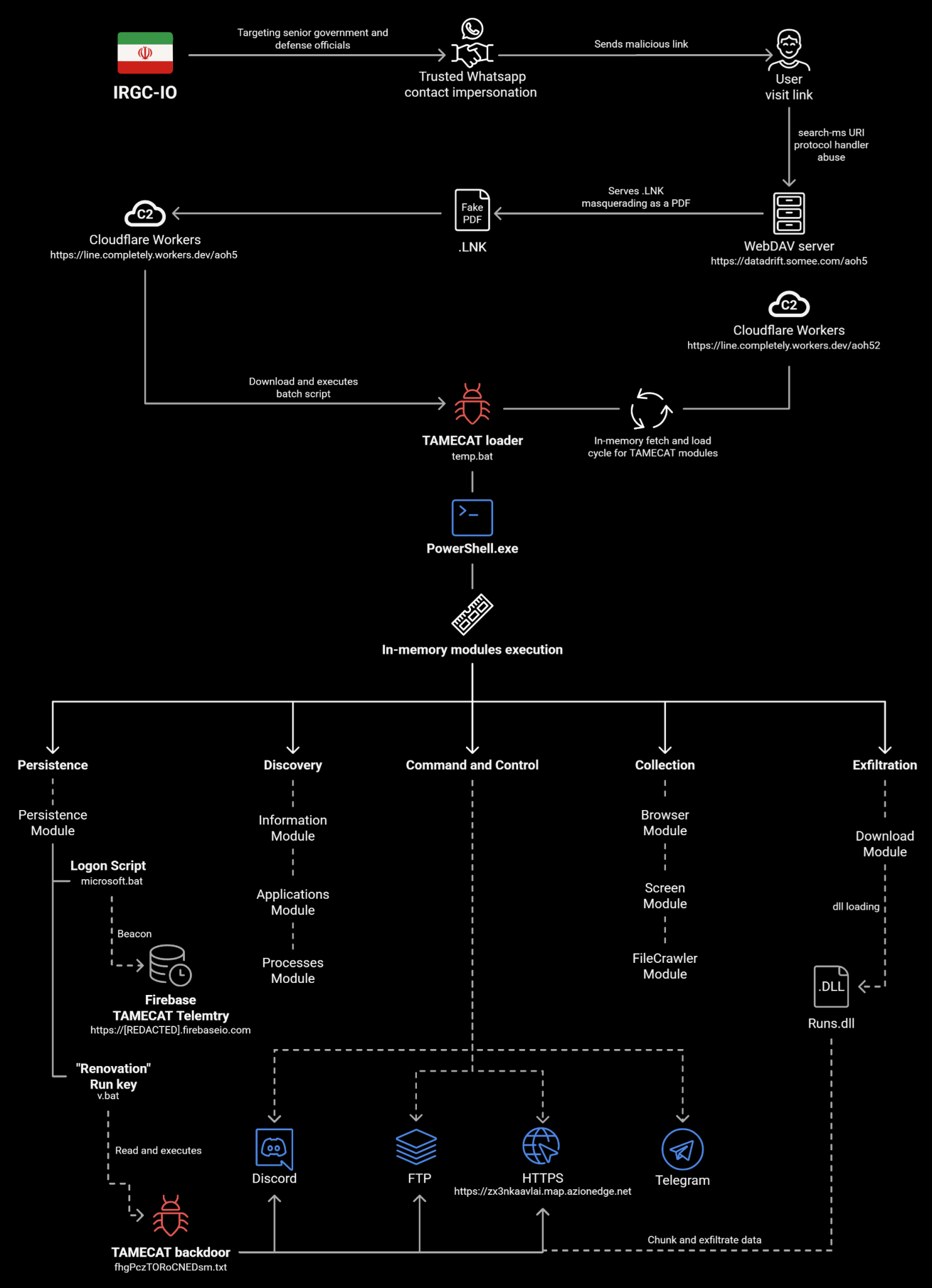
The central file, Document.pdf.lnk, poses as a harmless PDF. In reality, it launches cmd.exe and pulls a batch loader from cloud infrastructure. The loader then runs PowerShell in memory and fetches more modules.
TAMECAT works as a modular collection framework, not a simple downloader. It can grab browser cookies, Outlook mailboxes, screenshots, and staged files. Notably, it can start Microsoft Edge off-screen and pull decrypted cookies through the DevTools protocol.
AI-assisted phishing raises the bar
The report’s sharpest warning concerns language. According to DarkAtlas, “Language quality is now a weak phishing indicator.” Poor grammar once flagged many scams. That signal is fading fast.
DarkAtlas also notes that “APT42 appears to use generative AI as an operational accelerator.” The group uses it for target research, persona building, translation, and code work. Because of this, defenders can no longer treat clean writing as proof of safety.
Who is behind it
DarkAtlas attributes the exact shortcut and its infrastructure to APT42 with high confidence. The firm links the chain to a campaign likely aimed at the nuclear-energy sector. Even so, the researchers draw careful lines around overlapping “Kitten” aliases. An alias match alone does not prove shared authorship, they caution.
Law enforcement has already acted against related operators. US authorities charged three IRGC-linked individuals in 2024 over a similar phishing campaign. Reporting also cites a reward of up to $10 million for information on some suspects. Those figures come from public reporting and remain claims here.
Impact and scale
This was not mass phishing. Operators picked senior defense and government figures, and sometimes their families. In March 2026, TA453 activity hit a US think-tank employee during an active regional conflict.
The attacker allegedly impersonated a research director and used a genuine OneDrive document as bait. Only later did the sender share a malicious link. That link led to a fake OneDrive sign-in page, pre-filled with the target’s email.
How to stay protected
Old advice like “check whether the first link is Microsoft” no longer holds. Attackers now mix genuine cloud services with attacker-controlled redirects. Therefore, teams should verify the relationship and the request, not just the writing quality.
Simple checks that still work
Useful checks come down to a few questions. Does the final link jump to an unrelated domain? Does the sender’s address match the claimed institution? Did the chat suddenly move to WhatsApp or a personal inbox?
After a suspected compromise
A password reset is rarely enough on its own. Responders should revoke active sessions and invalidate refresh tokens. They should also inspect browser-stored credentials. In short, APT42 TAMECAT malware rewards defenders who watch identity, not just endpoints.
Support Our Threat Intelligence
Find our threat intelligence and malware analysis helpful? Support our work today and unlock a 100% ad-free reading experience!
 Buy Me a Coffee
