Beyond Pixel: Google Rebrands Magic Cue to Bring Proactive AI to All Androids
 Do Son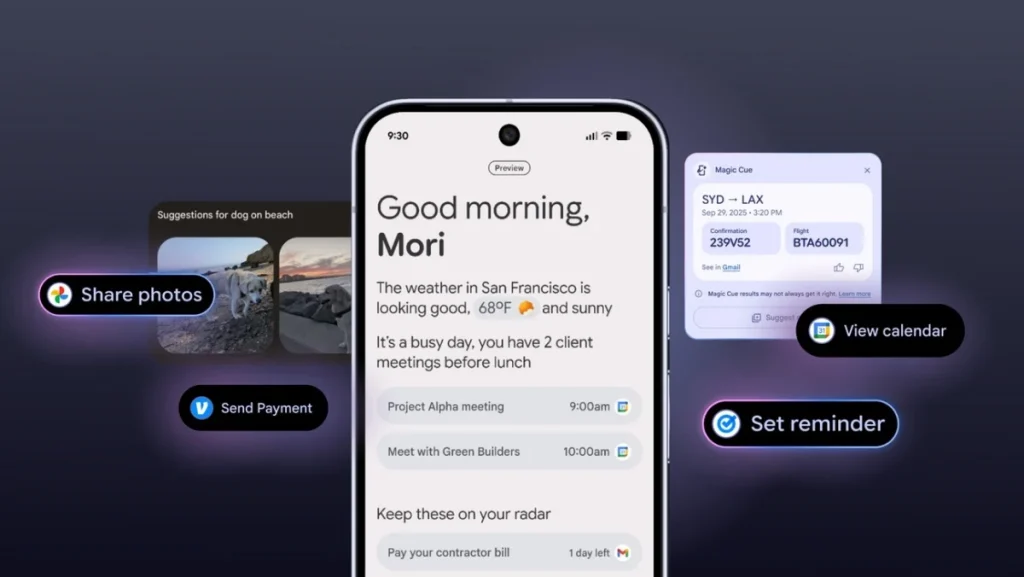
Earlier this year, Google introduced the Pixel 10 lineup with a headline AI feature called “Magic Cue,” designed to proactively offer services based on a user’s context. That capability now appears poised to break free from Pixel 10 exclusivity.
According to Android Authority, Google is preparing to streamline Magic Cue and rebrand it as “Contextual Suggestions,” rolling it out across the broader Android ecosystem via Google Play Services updates. Code and interface elements uncovered in a Play Services test build (v25.49.32) reveal a core logic strikingly similar to Pixel 10’s Magic Cue: the system synthesizes signals such as location, calendar entries, app usage patterns, and time of day to infer what a user might want to do next.
For example, when the system detects that a user has entered a gym, the notification shade may surface Spotify or YouTube Music workout playlists, enabling a quicker transition into training. Likewise, if a user routinely casts their phone to a TV on Sunday evenings to watch sports, the system can learn that habit and, at the appropriate time, prompt: “Cast your screen?” Because this feature relies on tracking location and behavioral patterns, privacy is—unsurprisingly—the foremost concern.
Google emphasizes in the settings panel that users retain full control over enabling or disabling the feature. All sensitive personal data is processed locally within the device’s encrypted Private Compute Core, using on-device computation rather than cloud uploads—unless a user explicitly consents during error reporting. Moreover, the temporary data used to learn habits is automatically deleted after 60 days, ensuring it is not retained indefinitely. This move clearly signals Google’s intent to deliver a more consistent AI experience across the Android ecosystem.
The concept itself is hardly new. Samsung has long offered a comparable feature in its “Now Brief,” and Apple’s “Siri Suggestions” have existed for years. Yet, candidly, such features have struggled to resonate deeply with users—often because AI predictions can miss the mark, transforming assistance into distraction.
Magic Cue on the Pixel 10 has been relatively well received, but Pixel devices occupy a modest share of the market. If Google can refine and deploy this capability across billions of Android devices—leveraging vast feedback loops while preserving privacy—it may finally address the perennial complaint that “AI doesn’t really understand me.”
Still, for this class of proactive AI to achieve true mainstream acceptance, Apple’s direction may prove decisive. The tech industry has long observed a curious pattern: features often gain widespread adoption only after Apple embraces them on iOS and christens them with a compelling marketing name. On the path toward “proactive AI,” Google may have moved first—but ensuring users perceive it as thoughtful rather than intrusive remains the greatest challenge.
Related Posts:
- StreetViewAI: Google’s Multimodal AI Brings Conversational Street View Navigation to the Visually Impaired
- The Memory Tax: OpenAI May Use ChatGPT Memory for Targeted Ads
- Google Ask Photos Relaunches: AI-Powered Search Now Faster, Smarter & Back for US Users
- Google Replaces Assistant with Gemini for Home AI and Unveils New Speakers & Nest Cams
Support Our Threat Intelligence
Find our tech and OS security coverage helpful? Support our work today and unlock a 100% ad-free reading experience!
 Buy Me a Coffee
