The AI-Powered Cybercrime Factory: Unmasking the Bluekit “All-in-One” Phishing Revolution
 Do Son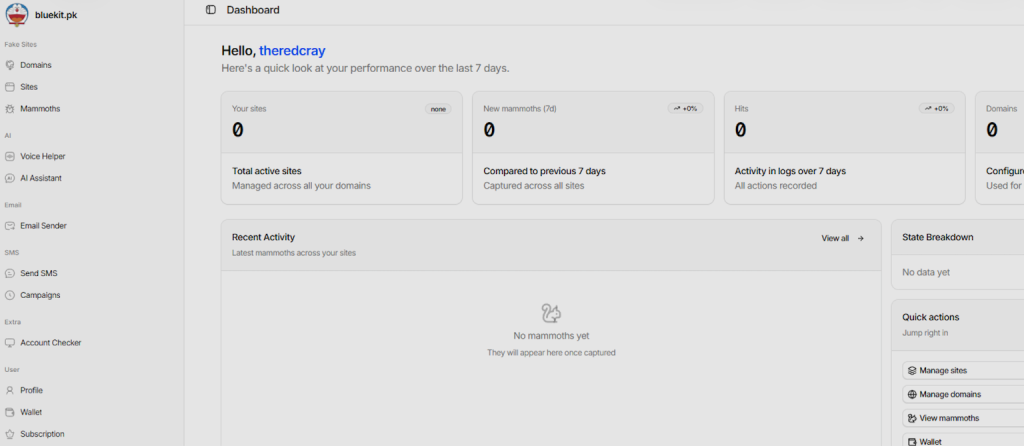
The Bluekit dashboard showing the main operator panel | Image: Varonis Threat Labs
Security researchers at Varonis Threat Labs have dissected a new, all-in-one phishing platform dubbed Bluekit that is attempting to revolutionize the “phishing-as-a-service” market. Unlike traditional kits that focus on single brands, Bluekit pitches a broader model, advertising over 40 website templates and a suite of advanced features designed to automate the entire lifecycle of a cyberattack.
Bluekit doesn’t just provide a fake login page; it acts as a centralized command center for operators, pulling site creation, domain registration, and victim logging into a single, cohesive dashboard.
The kit’s versatility is its primary selling point. Varonis reviewed templates covering a massive spectrum of the digital life, including:
- Cloud & Email: iCloud, Apple ID, Gmail, Outlook, Yahoo, and ProtonMail.
- Developer Platforms: GitHub and Zoho.
- Retail & Crypto: Zara, Ledger (including firmware update lures), and various social media services.
Researchers noted that Bluekit handles more than a basic credential grab. Through its “Mammoth Details” view, the kit tracks session states and performs repeated dumps of cookies and local storage, allowing attackers to hijack active sessions even if credentials are changed.
One of Bluekit’s most publicized features is its integrated AI Assistant. The panel offers access to several high-profile models, including an “abliterated” Llama default alongside variants of GPT-4.1, Claude Sonnet 4, and Gemini.
When Varonis tested the AI with an executive “quishing” (QR code phishing) scenario, the results were mixed: “The assistant returned a structured campaign draft, and much of it relied on placeholders instead of content that looked ready to use as-is.”
While the AI currently functions more as a campaign skeleton generator than a fully polished “phishing copilot,” its presence in the kit signals a dangerous trend toward lowering the barrier to entry for highly personalized social engineering.
To ensure the longevity of its malicious pages, Bluekit exposes granular controls that allow operators to:
- Automate Infrastructure: Buy and connect domains directly from the management interface.
- Cloak Attacks: Utilize antibot cloaking, geolocation emulation, and “headless” browser detection to hide from security analysts.
- Exfiltrate Data: Telegram is wired in as the default channel for sending captured logs to the operator.
Varonis emphasizes that Bluekit is in active development, with a release cadence that introduces new templates and features—like SMS sending and passkey enrollment bypasses—almost weekly. While it may currently lack the full automation of top-tier kits, its rapid evolution and broad brand coverage make it a significant threat to watch.
Support Our Threat Intelligence
Find our threat intelligence and malware analysis helpful? Support our work today and unlock a 100% ad-free reading experience!
 Buy Me a Coffee
