More Than a Miner: The Evasive MiningDropper Framework Hijacking Android Worldwide
 Do Son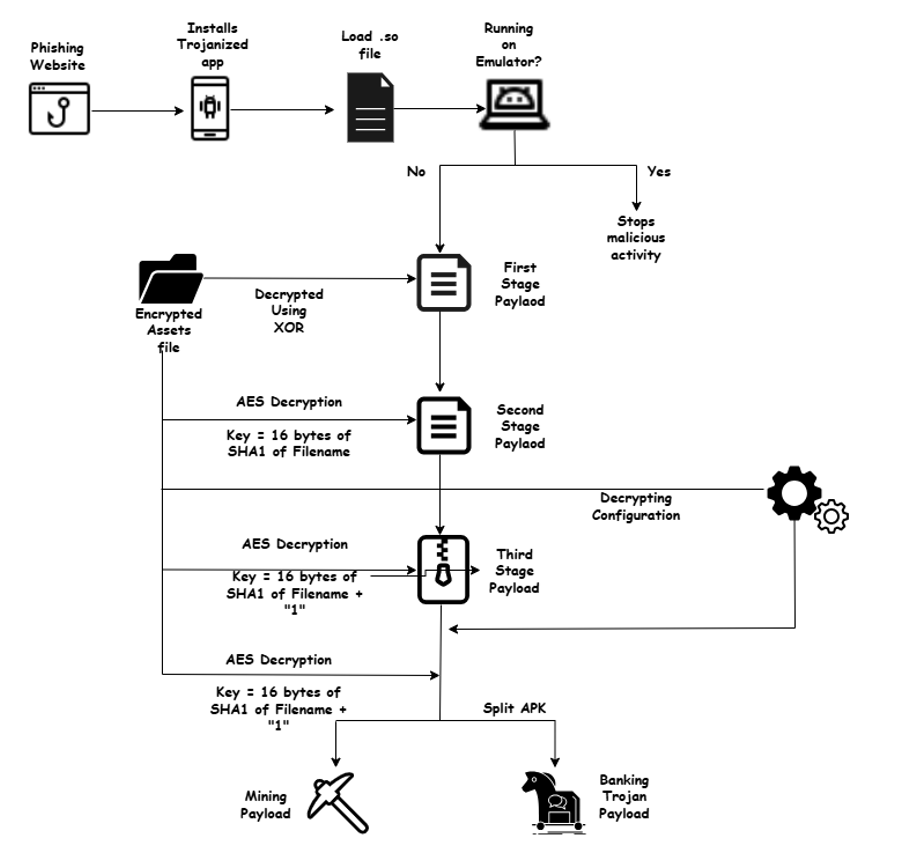
MiningDropper attack chain | Image: CRIL
Security researchers are sounding the alarm over a versatile and evasive Android malware delivery system that is rapidly evolving beyond its namesake function. A new investigative report from Cyble Research and Intelligence Labs (CRIL) has detailed the rise of “MiningDropper,” a sophisticated framework that seamlessly blends cryptocurrency mining with the deployment of high-level threats like infostealers and Remote Access Trojans (RATs).
What sets Mining Dropper apart from standard mobile threats is its complex, layered architecture designed to frustrate security analysts and automated sandboxes alike. According to the CRIL analysis, “MiningDropper employs a multi-stage payload delivery architecture that combines XOR-based native obfuscation, AES-encrypted payload staging, dynamic DEX loading, and anti-emulation techniques”.
This design allows the malware to remain dormant or hide its true intent during the initial infection phase. By utilizing a native bootstrapper and memory-only string deobfuscation, the framework ensures that its most malicious components never touch the device’s disk in a readable state.
In recent campaigns, threat actors have been observed leveraging a trojanized version of “Lumolight,” an open-source Android application project. By hiding malicious code inside a legitimate-looking utility, attackers can trick users into granting the permissions necessary for the framework to take root.
Once installed, the malware doesn’t just start mining; it evaluates the environment and checks its configuration to decide what the final “monetization objective” should be. Researchers noted that “the same loader family can deliver radically different end payloads with only configuration and asset changes”.
The impact of Mining Dropper is truly global, with specialized campaigns tailored to different regions:
- India: A notable infostealer campaign has been identified specifically targeting Indian mobile users.
- Global (LATAM, Europe, Asia): A widespread campaign is deploying the BTMOB RAT, a powerful tool that allows for real-time screen monitoring, file management, and audio recording via WebSocket-based communication.
The versatility of the framework is its greatest strength. “MiningDropper is better understood as a multi-payload Android delivery framework than a simple miner dropper,” the report clarifies. Whether the end goal is silent background mining or full-scale data exfiltration through a RAT, the core architecture remains consistent and effective.
Mining Dropper represents a maturing trend in mobile malware where modularity is king. By separating the distribution and installation framework from the final payload, threat actors can adapt to defensive measures in real-time.
As the CRIL team concludes, “this design allows the threat actor to reuse the same distribution and installation framework across hundreds of samples while adapting the final monetization objective to operational needs”. For users and security teams, this means that even a “simple” miner may be the precursor to a much more invasive and damaging infection.
Support Our Threat Intelligence
Find our threat intelligence and malware analysis helpful? Support our work today and unlock a 100% ad-free reading experience!
 Buy Me a Coffee
