ClickFix: The High-ROI “Living-off-the-Land” Trap Sweeping Windows and macOS
 Do Son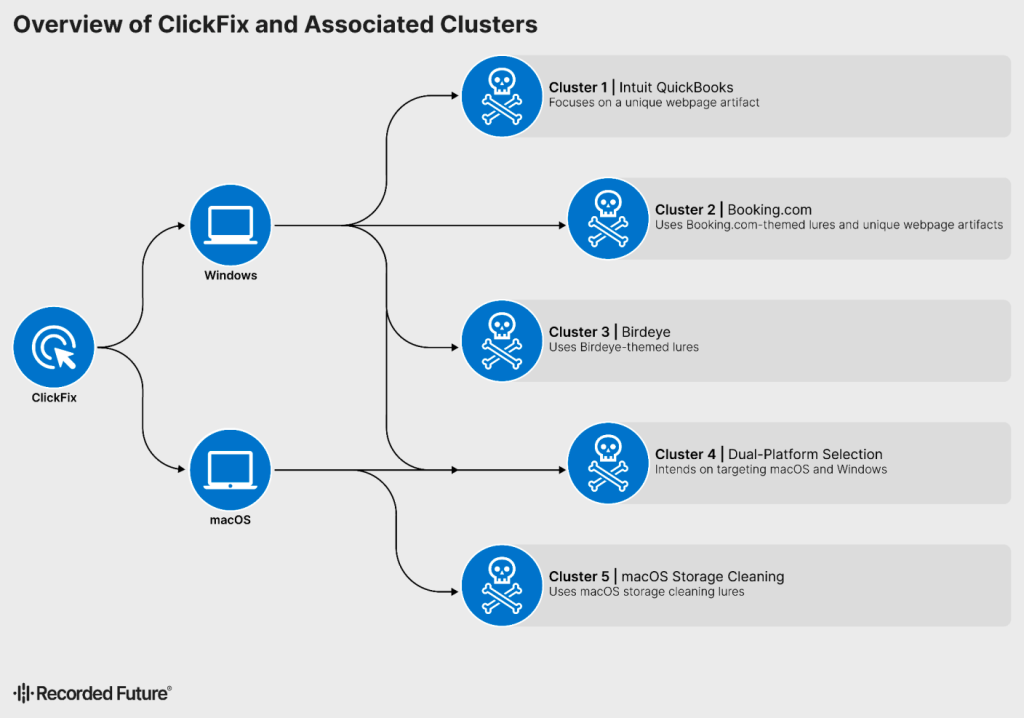
Overview of ClickFix and associated clusters | Image: Insikt Group
A sophisticated social engineering technique known as ClickFix has transitioned from a niche tactic into a standardized, high-ROI intrusion template. Originally documented in late 2023, ClickFix is now a cornerstone of the global cybercriminal ecosystem, leveraged by everyone from high-volume access brokers to state-sponsored APT groups like BlueDelta (APT28).
The brilliance of ClickFix lies in its simplicity. Instead of relying on complex exploit kits, it turns routine user actions into malware execution. Victims are lured into manually running malicious commands by masquerading as a necessary technical resolution for fabricated system errors or human-verification prompts.
According to the Insikt Group:
“The simplicity of relying on a manual user action makes it a potent defensive evasion tactic: bypassing typical browser-based security makes it difficult to detect, while the high number of threat actors using it makes it difficult to track across a fragmented threat landscape.”
Research has identified five distinct activity clusters that, while visually diverse, share a consistent execution framework. These clusters tailor their social engineering lures to specific sectors:
- Intuit QuickBooks (Cluster 1): Targets organizations during US tax season with lures impersonating accounting software.
- Booking.com (Cluster 2): Uses counterfeit reCAPTCHA v2 challenges, often asking victims to select photos of “buckets” to prove they are human.
- Birdeye (Cluster 3): Spoofs the AI marketing company Birdeye to deliver NetSupport RAT.
- Dual-Platform Selection (Cluster 4): Sophisticated enough to detect a user’s operating system and deliver tailored lures for both Windows and macOS.
- macOS Storage Cleaning (Cluster 5): Replicates Apple’s own styling and verbiage to trick users into “freeing up storage” via malicious Terminal commands.
ClickFix employs a Living-off-the-Land (LotL) approach, manipulating users into executing commands directly within trusted tools like the Windows Run dialog box or macOS Terminal. This allows malicious scripts to execute entirely in-memory, effectively bypassing traditional browser security and endpoint controls.
As noted in the report:
“This methodology allows threat actors to stage and run remote code with limited and short-lived forensic artifacts on the host system.”
Because ClickFix bypasses traditional signatures, defenders must prioritize behavioral hardening over simple indicator blocking. Key recommendations include:
- Disable Windows Run Dialog: Use Group Policy Objects (GPOs) to disable the Win+R shortcut and the Run command.
- Implement PowerShell CLM: Constrained Language Mode (CLM) can prevent the misuse of native binaries.
- Restrict Terminal Access: On macOS, use application control policies via MDM to limit unauthorized script execution.
- Targeted Training: Educate users specifically on the dangers of “manual verification” prompts that require copying and pasting commands.
Support Our Threat Intelligence
Find our threat intelligence and malware analysis helpful? Support our work today and unlock a 100% ad-free reading experience!
 Buy Me a Coffee
