From Taiwan to Tehran: How TA416 Pivots its PlugX Backdoor to Global Flashpoints
 Do Son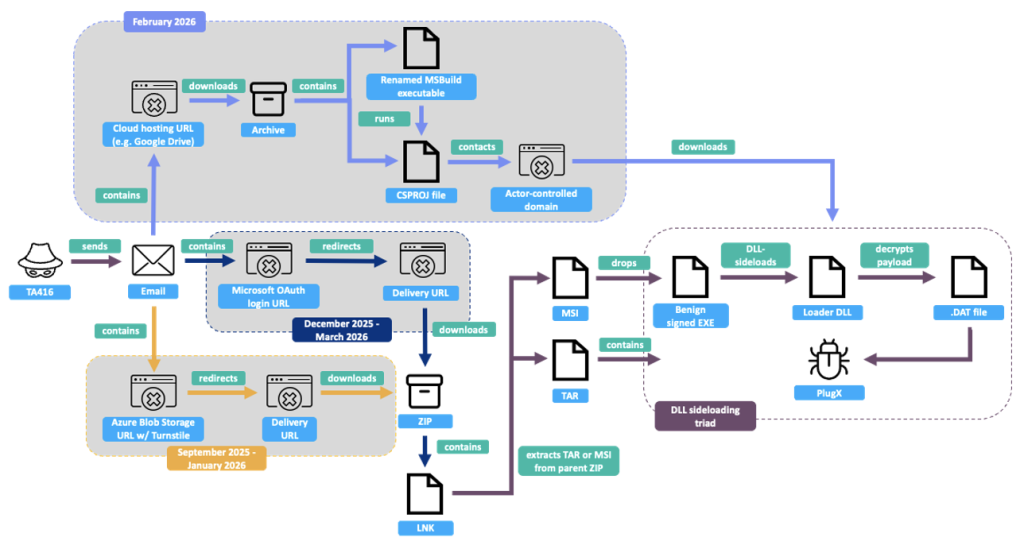
Evolving TA416 infection chain from September 2025 to March 2026 | Image: Proofpoint
A new intelligence report from Proofpoint reveals that TA416, a sophisticated threat actor aligned with Chinese state interests, has significantly shifted its targeting patterns to track with major geopolitical escalations in Europe and the Middle East.
After nearly two years of focusing primarily on Southeast Asia, Taiwan, and Mongolia, TA416 has resumed its pursuit of European government and diplomatic entities. This shift, which began in mid-2025, marks a return to the high operational tempo seen during the buildup to the conflict in Ukraine.
The group’s recent activity includes multiple waves of campaigns directed at diplomatic missions to the European Union and NATO. Researchers suggest this pivot is:
“…consistent with a renewed intelligence-collection focus against EU and NATO-affiliated diplomacy entities”.
The group’s adaptability was further demonstrated in March 2026. Following the outbreak of conflict in Iran, Proofpoint observed TA416 rapidly expanding its scope to include diplomatic and government entities in the Middle East.
This opportunistic expansion highlights a core characteristic of state-sponsored groups:
“…TA416’s expansion to Middle Eastern government targeting in March 2026 further highlights how the group’s tasking prioritization is likely influenced by geopolitical flashpoints and escalations”.
TA416 does not rely on a stagnant playbook. To bypass modern defenses, the group frequently iterates on its infection chains and delivery methods. Recent campaigns have seen the group cycling through several sophisticated techniques, including:
- Web Bug and Malware Delivery: Using transparent tracking to profile targets before a strike.
- Deceptive Challenges: Abusing Cloudflare Turnstile pages to make malicious links appear legitimate.
- Identity Abuse: Exploiting OAuth redirects to hijack user sessions.
- Developer Tooling: Utilizing C# project files and MSBuild-based delivery to blend into technical environments.
Despite the variety of entry vectors, the ultimate goal often remains the same: the deployment of a customized PlugX backdoor. This payload, which has been frequently updated throughout 2025 and 2026, grants the attackers long-term, stealthy access to the most sensitive diplomatic networks.
As geopolitical tensions remain high, Proofpoint assesses that TA416 will likely continue to prioritize European and Middle Eastern diplomatic targets. Organizations operating in these sectors should remain vigilant for spearphishing attempts that leverage these evolving tactics.
The report concludes with a clear warning for defenders:
“Organizations in scope for this targeting should expect continued experimentation with initial access vectors delivered via spearphishing campaigns alongside continually updated PlugX payloads”.
Support Our Threat Intelligence
Find our threat intelligence and malware analysis helpful? Support our work today and unlock a 100% ad-free reading experience!
 Buy Me a Coffee
