The Next.js Nightmare? Vercel Investigates “Critical” Internal Breach and Supply Chain Threat
 Do Son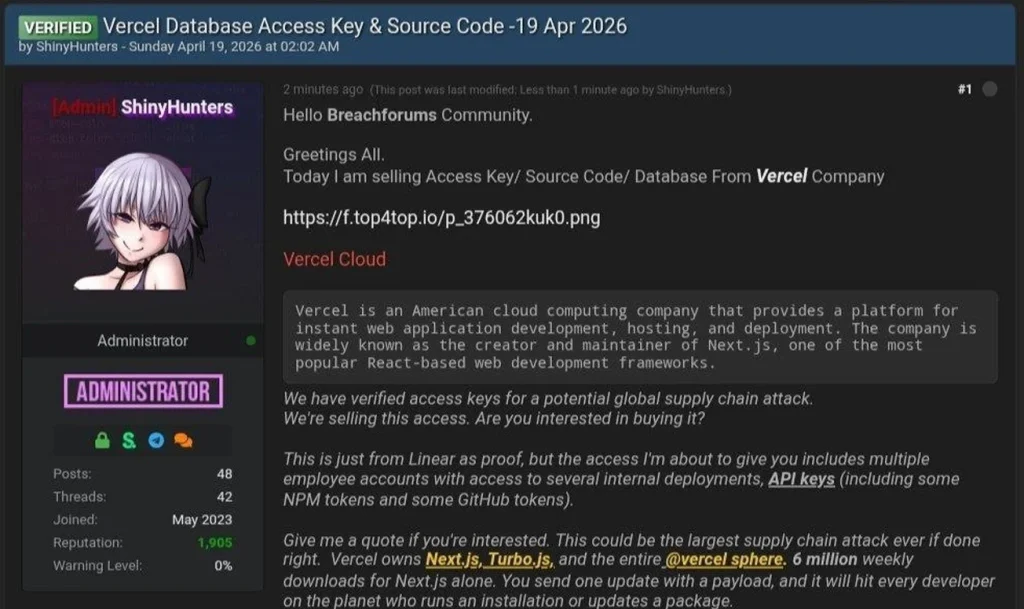
The global development community is on high alert following reports of a major security incident at Vercel, the American cloud computing giant and the primary maintainer of Next.js. On April 19, 2026, a threat actor claiming to be part of the “ShinyHunters” extortion group posted a high-stakes listing on a prominent hacking forum, claiming to offer the “largest supply chain attack ever” for sale.
The breach first came to light when a user identified as an administrator for “ShinyHunters” posted that they had successfully breached Vercel’s internal infrastructure. The actor is allegedly selling a treasure trove of sensitive assets, including:
- Source Code and Databases: Proprietary code and database access keys allegedly stolen from Vercel.
- Supply Chain Tokens: Critical API keys, including NPM and GitHub tokens, which are essential for managing the @vercel ecosystem.
- Employee Data: A text file containing 580 records of Vercel employee names, internal emails, and activity timestamps.
To prove the legitimacy of the claim, the actor shared a screenshot of an internal Vercel Enterprise dashboard and a snippet of data from the project management tool Linear.
“Vercel owns Next.js, Turbo.js, and the entire @vercel sphere. 6 million weekly downloads for Next.js alone. You send one update with a payload, and it will hit every developer on the planet,” the threat actor boasted in the forum post.
Vercel has officially acknowledged the security incident, confirming that an investigation is underway regarding unauthorized access to certain internal systems. While the company has not confirmed the full extent of the actor’s claims, it has stated that a “limited subset of customers” was directly impacted.
Key points from Vercel’s response:
- Operational Status: Vercel’s core services remain operational during the investigation.
- Expert Assistance: The company has engaged third-party incident response experts, including Google Mandiant and Context, to help remediate the threat.
- Law Enforcement: Official authorities have been notified of the breach.
A major point of concern for developers is the safety of their environment variables (secrets). Vercel clarified that variables marked as “sensitive” are stored using a method that prevents them from being read. At this time, Vercel maintains there is no evidence that these specific “sensitive” values were accessed.
However, the company warns that any environment variables containing secrets—such as API keys or database credentials—that were not marked as sensitive should be treated as potentially exposed and rotated immediately.
For the millions of developers and organizations relying on the Vercel platform, the company has issued a set of critical best practices:
- Secret Rotation: Treat any non-sensitive environment variables as compromised and rotate those keys as a priority.
- Audit Logs: Review activity logs in the Vercel dashboard or via the CLI for any suspicious or unrecognized activity.
- Update Practices: Follow the official Vercel April 2026 Security Incident bulletin closely for real-time updates.
As the investigation progresses, the focus remains on whether the attackers managed to tamper with the Next.js or Turbo.js repositories. In a world where 6 million developers download Next.js weekly, a poisoned update could represent a supply chain catastrophe of unprecedented proportions.
Support Our Threat Intelligence
Find our threat intelligence and malware analysis helpful? Support our work today and unlock a 100% ad-free reading experience!
 Buy Me a Coffee
