ToneShell Backdoor Evolves With Anti-Analysis Tricks, Continues Targeting Myanmar
 Do Son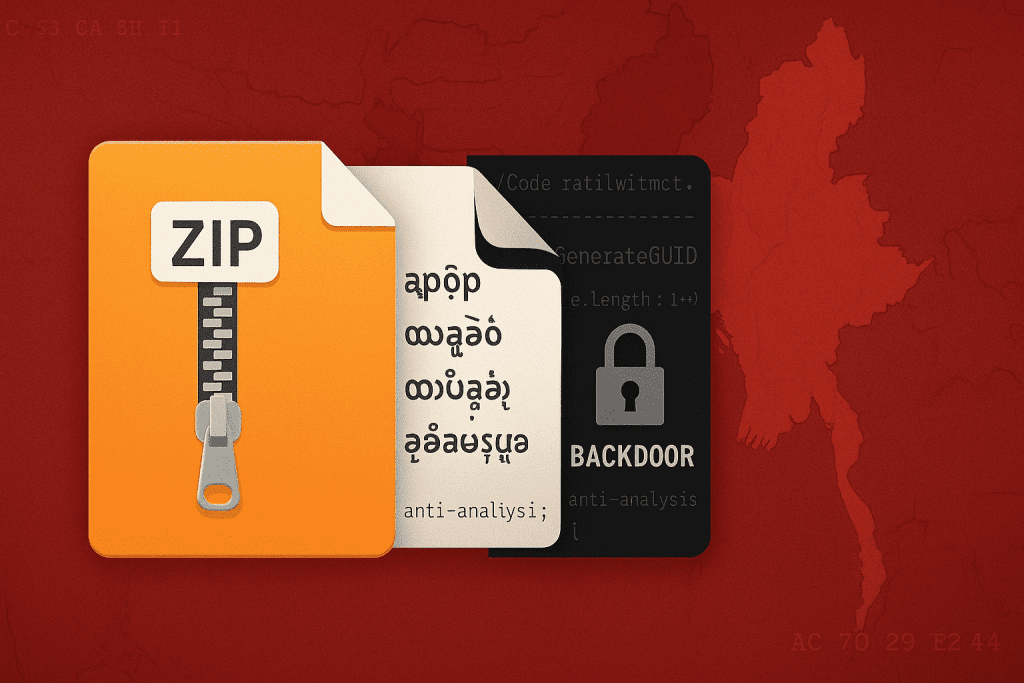
Intezer researchers have released a technical analysis of a new variant of ToneShell, a lightweight backdoor tied to the China-nexus group Mustang Panda. This malware family, previously documented for its FakeTLS communication protocol and minimal command set, is now demonstrating enhanced anti-analysis capabilities while maintaining its focus on targets in Myanmar.
According to Intezer, “ToneShell is a lightweight backdoor tied to the China-nexus group Mustang Panda. Typically delivered via DLL sideloading inside compressed archives with legitimate signed executables and often spread through cloud-hosted lures.” The report highlights that recent activity is particularly notable in Myanmar, reflecting China’s strategic interests in border security, infrastructure projects, and political developments.
This aligns with Mustang Panda’s long-running pattern of using cyber operations to reinforce geopolitical influence in neighboring states.
The sample analyzed by Intezer was distributed in a ZIP archive masquerading as a document related to Myanmar’s revolutionary forces. The backdoor was delivered as a DLL named SkinH.dll, compiled in July 2025.
ToneShell ensures persistence by copying itself into the user’s AppData directory and registering a scheduled task named dokanctl, which executes every minute. It also enforces a single-instance mutex to prevent multiple infections.
The malware checks for the presence of Google Drive-related processes—a likely attempt to avoid infecting its operators’ own systems.
What makes this variant stand out is its emphasis on wasting analyst time and confusing automated tools. As Intezer notes, “This ToneShell variant employs several stalling and anti-sandboxing tricks designed to waste time, confuse automated analysis, and evade lightweight sandboxes.” These include:
- Repeated file churn – creating and deleting temporary files in loops.
- Randomized sleep delays – slowing execution by more than 20 seconds.
- Tick count checks – ensuring sandboxes that don’t advance time realistically get stuck.
- Opaque string comparisons & junk arithmetic – obfuscating control flow with meaningless calculations.
- Decoy API calls – inserting irrelevant system calls with fake error codes.
Notably, the binary includes large embedded strings copied from OpenAI’s blog on image generation and Pega AI’s website. These serve no functional purpose but inflate the code and act as filler for anti-analysis loops.
The malware connects to its command-and-control server at 146.70.29[.]229:443. It uses a TLS-like header to disguise its traffic and then applies a rolling XOR scheme to obfuscate its payload. Intezer explains that each packet is structured as “[TLS-like header][XOR-obfuscated type | code | body…], with the header stripped before the data is available to the rest of the malware.”
ToneShell also generates a unique GUID identifier per victim, storing it locally for persistence across sessions.
Researchers describe this sample as a hybrid, blending features from earlier versions. “Interestingly, while the GUID generation logic in this sample aligns with the first version of ToneShell described by Zscaler, the communication protocol remains identical to the second version.” This suggests Mustang Panda is experimenting with incremental changes to maximize stealth while maintaining tried-and-true methods.
The new ToneShell variant underscores Mustang Panda’s persistent cyber espionage operations in Myanmar. While it does not introduce groundbreaking capabilities, its anti-analysis design, geopolitical targeting, and continued refinement highlight the group’s adaptability.
As Intezer concludes, “The continuous refinement of these evasion methods, coupled with the geopolitical significance of the targeted region, reinforces the need for ongoing research and threat hunting to counter cyber operations.”
Related Posts:
- Fake Shops, Real Theft: Android Malware Targets Banks
- Mustang Panda Backdoor Exposed: New ToneShell Malware Masquerades as Chrome to Spy on Gov’t & Military
- China-Linked Mustang Panda Targets Vietnamese Entities in Cyber Espionage Campaign
- ToneShell Backdoor Targets IISS Defence Summit Attendees in Latest Espionage Campaign
- Silver Fox APT Targets Organizations with PNGPlug and ValleyRAT Malware
Support Our Threat Intelligence
Find our threat intelligence and malware analysis helpful? Support our work today and unlock a 100% ad-free reading experience!
 Buy Me a Coffee
